
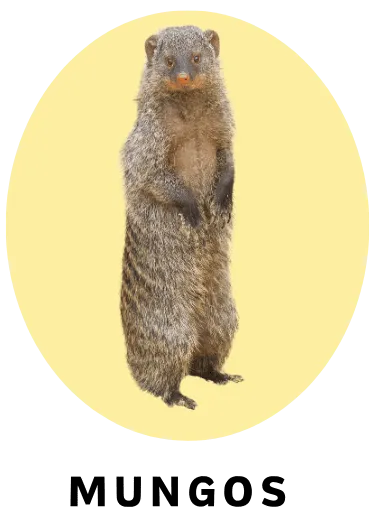
Raising a baby mongoose
Found a baby mongoose? What to do and why you must not release it
On Mljet, Korčula, Pelješac and in parts of southern Dalmatia, people sometimes find a baby mongoose by the road, in the garden or in a dry-stone wall and ask me how to raise it. This article is a little different from the other rearing articles on our website. The small Indian mongoose (Herpestes auropunctatus, in older literature Herpestes javanicus) is an invasive alien species in Croatia, so the same rules do not apply to it as to a young hedgehog or squirrel. Here you can read, honestly, what you may and may not do if you find a baby mongoose.
How to recognise a young mongoose
The mongoose is a small, slender carnivore with an elongated body, short legs and a long, bushy tail that tapers towards the tip. It has a pointed snout, short round ears and greyish-brown fur finely flecked with golden speckles. The young look like miniature adults, just with softer fur.
It is easy to mistake it for a young marten or weasel, which are our native species. The marten has darker fur and a pale patch on its throat, while the weasel is smaller, reddish-brown above and white below. If you are not sure what animal it is, take a photo and send it to a vet or an association before doing anything, because native species are handled completely differently.
Is the young mongoose really alone?
The female mongoose gives birth to several young in a hiding place, usually a hole in the ground, under stones, in a dry-stone wall or in dense scrub. Their eyes open after about ten days, and at three to four weeks they start coming out and exploring while the mother is nearby. The mother may also move them from one hiding place to another.
A youngster that is not injured and is near its hiding place is very probably not abandoned. In that case, do not touch it or take it away. Move away; you can report the sighting to the relevant authorities, as described below. Nobody expects you to catch wild animals yourself.
Why must a mongoose not be released into the wild or relocated?
The mongoose was introduced to our islands at the beginning of the 20th century, first to Mljet, to reduce the number of nose-horned vipers. This turned out to be a big mistake. The mongoose eats almost anything it catches: reptiles, amphibians, small mammals, insects, eggs and ground-nesting birds, so it is a serious threat to island species. From Mljet it spread to Pelješac, Korčula, Hvar, Čiovo and other islands, and further to the mainland and neighbouring countries.
That is why it is on the list of invasive alien species of Union concern in the European Union. Under European and Croatian regulations, such species must not be:
- released into the wild, either where they were found or anywhere else,
- kept at home as pets, bred or allowed to reproduce,
- transported, sold, given away or exchanged.
Do not take it into a car or onto a boat either, even with good intentions, because this is exactly how the mongoose spreads to new areas – as a “stowaway”. Arrange any move, even a trip to the vet, with the relevant authorities.
The young mongoose is injured or you have already picked it up: how do you house it temporarily?
If you have already brought the youngster home, or it is obviously injured and in immediate danger, look after it safely and temporarily, only until you receive instructions:
- handle it only with thick gloves or move it using a towel, because even young mongooses bite quickly and hard,
- put it in a sturdy, securely closed box or carrier with air holes; mongooses are skilled at escaping and can squeeze through very small gaps,
- line the box with a towel and keep it in a quiet, darkened room, away from children and pets,
- if the youngster is cold, warm it with a hot-water bottle wrapped in a towel under one part of the box, so it can move away.
Do not feed it or give it water while it is cold, and never give it cow’s milk. If help cannot arrive straight away, ask a vet whether you may give it anything, and what. Mongooses are not raised at home, so I deliberately do not give instructions for long-term rearing here.
Who should you contact if you find a mongoose?
If you find a baby mongoose, contact one of the following:
- a vet, especially if the youngster is injured, ill or has been attacked by a dog or cat,
- the Državni inspektorat (State Inspectorate), i.e. the nature protection inspectorate, which oversees the handling of invasive alien species,
- the public nature protection institution of your county,
- you can also report the sighting via the official mobile app and website on invasive species in Croatia, run by the ministry responsible for nature protection.
In Croatia the mongoose is also a game species, so you can also notify the holder of the hunting rights in that area. A list of contacts for associations and wildlife rescue centres is available on our website; they can help you find the right contact.
What happens next to the young mongoose?
I will be honest, because I believe people deserve to know the truth. The mongoose’s fate is decided by the relevant authorities and a vet, not by the person who found it. A mongoose is not returned to the wild or rehomed as a pet. Depending on the circumstances, this may also mean humane euthanasia carried out by a vet, without suffering for the animal.
I know this is hard to accept when you are holding a small, helpless creature in your hands. But every mongoose released into the wild means fewer lizards, snakes, frogs and birds, and island species often have nowhere to escape to. Caring for nature sometimes calls for decisions like this.
Can a mongoose pass diseases on to people and pets?
The mongoose can carry rabies, leptospirosis and trichinellosis, and it also has fleas and ticks. So never touch it with bare hands, do not let children play with it and keep it away from dogs and cats. After every contact, even with gloves, wash your hands well with soap. If it bites or scratches you, immediately rinse the wound thoroughly with soap and water and see a doctor, who will assess whether rabies protection is needed. If a dog has had contact with a mongoose, let your vet know.
Conclusion: help the mongoose by leaving it to the authorities
Do not touch or take away a baby mongoose that is not injured. If it is injured or you have already picked it up, put it in a sturdy closed box somewhere warm and quiet, handle it only with gloves and contact a vet or the relevant authorities straight away. Never release it into the wild or move it somewhere else. This way you protect both yourself and our native wildlife.