
Raising a baby wren
Raising a baby wren: what to do if you find a young wren
The wren (Troglodytes troglodytes) is one of our smallest birds, and its chicks weigh only a few grams. That is why raising a baby wren is more demanding than with most garden birds: the chick chills quickly, its food must consist only of insects, and mistakes are hard to put right. Before you pick it up, check whether it needs your help at all. If it does, this article explains how to help it in the first hours and days, until a wildlife rescue centre takes over.
I’ve found a baby wren: is it really abandoned?
Most chicks that people “rescue” did not actually need help. The wren builds a round moss nest with a side entrance, hidden in ivy, a hedge, a crack in a wall, a woodshed or among roots. The young leave it before they can fly well and hide in dense vegetation for a few more days, where the parents – often mainly the male – continue to feed them.
- Fledgling: covered in feathers, with a short, newly grown tail; it hops about, hides and calls loudly. This is a normal stage. Leave it alone, keep children and pets away and watch it from a distance for at least an hour or two. If it is in a dangerous spot, move it to the nearest dense bush, close to where you found it.
- Nestling or sparsely feathered chick: it belongs in the nest. If you can see the nest, put it back as soon as possible. The smell of human hands will not put the parents off.
- A chick that needs help: one that is injured, cold and limp, found next to dead parents, has been in a cat’s mouth, or whose parents have not come back even after several hours of watching.
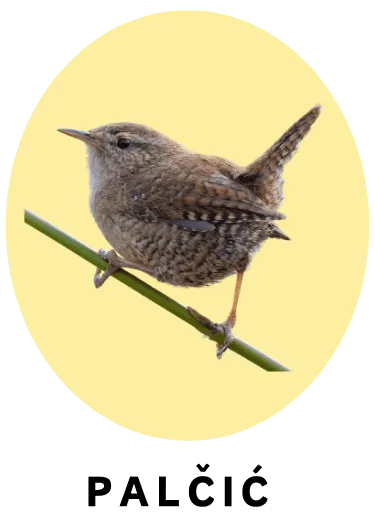
A young wren can be recognised by its tiny body, thin beak with yellowish edges and yellow-orange gape when it opens its beak.
First steps: warmth before food
When someone brings me a cold chick, I warm it up first and only then think about food. Never feed a chilled chick, because it cannot digest food, and this can kill it.
- First warm the chick in your cupped hands, then put it in a “nest” made from a rolled-up woollen sock or a small container lined with kitchen paper. Do not use cotton wool, as it gets tangled around the little legs.
- Put the nest in a cardboard box with air holes, on a hot-water bottle or a small bottle of warm water wrapped in a cloth. Naked chicks need roughly 32 to 35 °C, feathered ones a little less, around 26 to 30 °C. The chick must not pant or hold its wings away from its body – that means it is too hot.
- Partly cover the box and keep it in a quiet, darkened room, away from children and pets.
- Do not put water in its beak, either with a dropper or a syringe. A droplet easily gets into the airway and the chick suffocates. The chick gets its fluids from its food.
- Take an injured chick, a chick that has been in a cat’s mouth or one that will not open its beak straight to an avian vet or a wildlife rescue centre. A list of contacts for associations and wildlife rescue centres is available on our website.
What do baby wrens eat?
The wren is a delicate insectivore. In the wild its parents feed it tiny spiders, caterpillars, larvae and soft-bodied insects, so any substitute must also consist only of insects.
- Suitable: freshly killed or thawed small crickets, flies, soft white larvae (for example waxworms), drone brood. For very small chicks, cut everything into beak-sized pieces.
- Do not give: bread, milk, boiled egg, oats, seeds, dog or cat food, earthworms, or live larvae and mealworms. Earthworms can transmit parasites, and live larvae can injure the digestive system of such a tiny chick.
- Bought insects are not as nutritious as wild ones, so for longer-term rearing rescue centres add vitamin and mineral supplements. Agree with a vet or rescue centre on which ones and how much.
How do you feed a baby wren?
Feed it with blunt tweezers, slowly and without rushing. The chick must be in a natural position, on its tummy or upright, never on its back.
- When it gapes, place the morsel deep in the throat, behind the opening of the windpipe at the base of the beak, and wait for it to swallow before giving the next one.
- Naked and very young chicks eat roughly every 30 to 45 minutes, from sunrise to sunset. Feathered fledglings eat less often, roughly every hour. No feeding at night.
- A chick that is full stops gaping and dozes off. Do not force food on it.
- If the chick still does not open its beak after being warmed, do not force its beak open. Contact a wildlife rescue centre, because force-feeding such a tiny bird is a job for experienced hands.
I’ve learned from experience that regularity is what matters most. If you cannot feed the chick all day, it is better to hand it over straight away to someone who can.
Hygiene and housing
Songbird chicks produce their droppings in small sacs, usually right after feeding. Change the paper in the nest after each dropping so the feathers stay clean and dry. Runny, watery or greenish droppings are a sign that something is wrong, and you should then contact a vet.
- Wash your hands before and after every feed. Clean the tweezers regularly and boil them.
- Birds can carry bacteria such as salmonella, but with basic hygiene there is no reason to be afraid.
- When the chick starts leaving the nest and climbing, move it to a soft flight space, for example a mesh tent or a fabric carrier. A wire cage damages the feathers.
- Limit contact: do not stroke it, do not show it to visitors and do not talk to it. A wild bird must stay shy.
When does a wren start feeding itself?
Once it is fully feathered and starts pecking at everything around it, it is time to learn independence. Offer it a shallow dish of small live insects. The insects’ movement awakens its hunting instinct. Put twigs, moss and bark in its enclosure for it to pick food from and, if possible, a plant with aphids. Gradually reduce feeding with tweezers. A shallow dish of water for drinking and bathing is now a good idea.
The wren is ready when it eats enough by itself, flies well and moves nimbly through vegetation. By then, several weeks of care have usually passed.
When and how should a wren be released into the wild?
- Release it in the morning, in dry and warm weather, so it has the whole day to find its way.
- Choose a place with dense shrubs, hedges, ivy and plenty of insects, ideally near where it was found, away from traffic and cats.
- Gradual release is best: open the space it has been living in and leave food for a while in a spot it can come back to.
- Never throw it into the air to see whether it can fly.
Conclusion
A young wren grows up best with its parents, so often the greatest help is not to touch it. If it really does need help, warmth comes before food, food means insects only, and water never goes into the beak. All wild birds in Croatia are protected by law. Long-term rearing and keeping of wild birds is only permitted for licensed wildlife rescue centres, so contact a vet or a rescue centre as soon as possible. The goal is always the same: for the wren to return to the wild.