
Raising a baby tortoise
Raising a baby tortoise: found a young tortoise or turtle? What to do and what it eats
When someone finds a baby tortoise, the first question is usually what it eats and how to raise it. The good news is that young tortoises and turtles do not need their parents: they are independent from the moment they hatch and never drink milk. In the wild in Croatia we most often come across the land-dwelling Hermann's tortoise (Testudo hermanni) and the aquatic European pond turtle (Emys orbicularis). Both are strictly protected, so raising a baby tortoise at home is almost never the right solution.
Is the baby tortoise really abandoned?
The female lays her eggs in the ground and does not look after them any further. The young hatch in late summer or autumn, and some of them overwinter in the nest and only come out in spring. From day one they find food and shelter on their own. So a baby tortoise you find in the wild is not an orphan and does not need its mother.
- Leave a healthy young Hermann's tortoise exactly where you found it, or place it under a nearby bush or pile of leaves. Do not take it to a “better place”.
- Leave a young pond turtle that is on land near water in peace or, if it is on a path, carry it to the edge of the nearest water.
- If it had to be moved off a road, carry it to the side it was heading towards.
It needs help if its shell is cracked or damaged, if it has a wound, swollen or closed eyes, if it has been bitten by a dog, if it is completely limp, or if it was found out in the cold in the middle of winter. In that case contact a vet or a wildlife rescue centre straight away. A list of associations and rescue centres is available on our website.
Which tortoise or turtle have you found?
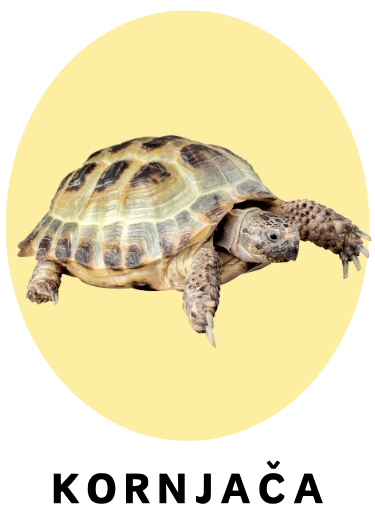
- Hermann's tortoise is a land tortoise with a domed, yellowish shell with dark patches and a horny spur at the tip of its tail. It lives in maquis, dry meadows and along dry-stone walls on the coast and the islands.
- The European pond turtle has a flatter, dark shell and dark skin speckled with tiny yellow dots. It lives in ponds, canals, oxbow lakes and slow-flowing rivers.
- The red-eared slider (Trachemys scripta) has greenish skin with yellow stripes and a red or orange patch behind the eye. It is a North American species that people kept as pets and released into the wild, and today it is an invasive alien species.
If you find a young land tortoise in your garden, check with your neighbours whether it is their pet or a youngster from their garden.
Can I keep a baby tortoise?
No. Hermann's tortoise and the European pond turtle are strictly protected species in Croatia. It is forbidden to catch, disturb, keep or sell them, and this applies to the young as well. A tortoise found injured may only be cared for temporarily until a vet or rescue centre takes it over, and the aim is always to return it to the place where it was found.
A different rule applies to the red-eared slider: it must never be released into the wild, because it displaces the European pond turtle and spreads diseases. If you find one or can no longer keep it, contact the nature protection authorities or a shelter for such turtles.
How to house a baby tortoise temporarily
Tortoises and turtles are cold-blooded, so my rule applies here too: warmth first, food later. A cold tortoise cannot digest food.
- Put a young Hermann's tortoise in an open plastic tub or box with a substrate of damp soil or leaves, a hiding place and a very shallow dish of water that it can easily climb out of.
- Make one end warmer and the other cooler, so it can choose its own temperature. Never leave it in a closed glass container in the sun, as it overheats quickly.
- You can bathe an exhausted land tortoise for about ten minutes in shallow lukewarm water up to the level of its lower shell; this way it drinks and replaces lost fluids.
- A young pond turtle needs shallow lukewarm water to swim in and a dry, warmer spot it can climb onto by itself.
What does a baby tortoise eat?
Young tortoises and turtles do not drink milk and do not need to be hand-fed. They eat on their own, and their food depends on the species:
- A young Hermann's tortoise is a herbivore. Wild plants from unsprayed meadows are best: dandelion with its flowers, plantain, clover, mallow and similar herbaceous plants. Its food should be high in fibre and low in protein. Do not give it large amounts of fruit, or bread, meat, dairy products or dog and cat food. A piece of cuttlebone in the box is a good source of calcium.
- A young European pond turtle is a carnivore and eats only in water: small earthworms, insect larvae, aquatic invertebrates and small snails.
I've learned from experience that overfeeding is a common mistake: the tortoise grows too fast and its shell becomes uneven and lumpy. A young tortoise needs a moderate meal once a day, sunlight or suitable UV light and plenty of exercise.
Does a baby tortoise need to hibernate?
In the wild, tortoises and turtles hibernate in their very first winter: Hermann's tortoise buried in soil and leaves, and the pond turtle in the mud at the bottom of the water. That is why it is best for healthy youngsters to go back to the wild before the cold days and overwinter there naturally.
If a tortoise has to stay in care over the winter because of illness or injury, a vet must decide about hibernation. A sick, underweight or dehydrated tortoise must not hibernate. A healthy tortoise hibernates at a constant temperature of about 4 to 6 °C, because it can die if it freezes, while at warmer temperatures it uses up its reserves and wakes up exhausted. Never leave it in a warm room to “doze”.
Salmonella and hygiene: are tortoises dangerous to people?
Tortoises and turtles, even ones that look perfectly healthy, often carry salmonella bacteria in their gut and shed them in their droppings. The bacteria are found on the shell, in the water and in the box where the animal lives. So:
- wash your hands thoroughly with soap after every contact with the tortoise, its food or its dishes,
- do not kiss the tortoise and do not touch your mouth while handling it,
- do not wash its dishes in the sink where food is prepared,
- take particular care with small children, older people and anyone with a weakened immune system.
Conclusion: a baby tortoise belongs in its habitat
A baby tortoise is independent from day one and needs neither its mother nor milk. Leave a healthy tortoise where you found it; house an injured one temporarily somewhere warm and quiet and call a vet or rescue centre straight away. Protected tortoises and turtles go back to the place where they were found, ideally in the morning on a warm day, under a bush or at the water's edge. Never release a red-eared slider into the wild. That way you protect both the tortoises and yourself.