
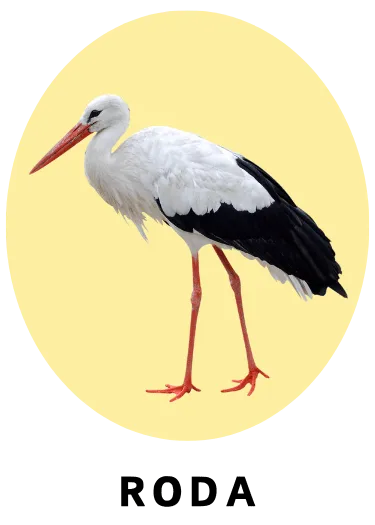
Raising a baby stork
How to Care for a Baby Stork Properly:
Have you found a baby stork and want to help it survive and eventually be released into the wild? Caring for a stork requires special attention and knowledge of its needs. This guide gives you all the information you need on how to care for a baby stork properly, from the first day until it is ready for life in the wild.
How to Tell Whether a Stork Needs Help
Before you intervene, it is important to distinguish a young stork that needs help from one that is simply out of the nest for the moment
Here's how to tell:
A stork that needs help
Has no feathers or is only partly covered in down.
Cannot stand or can barely move. Is in a dangerous place (e.g. by a road, near predators).
Is obviously injured or undernourished.
A young stork being fed by its parents, i.e. a fledgling
Has feathers and can hop or fly short distances.
Is in a safe place (e.g. near the nest).
Its parents are nearby and come to feed it.
When should you step in?
If the stork is in danger (e.g. on a road), move it to a safe place nearby.
If the stork is injured or abandoned, take care of it.
If it is a young stork being fed by its parents, don't take it. Its parents are best for its survival.
What to Do After Finding a Baby Stork
If you have established that the stork really does need help, the first priority is to keep it warm and safe. Young storks lose heat quickly, so put them in a box with a soft lining (e.g. paper towels) and keep them in a warm place.
How to keep a baby stork warm:
Use a heating pad set to a low temperature or a warm bottle wrapped in a cloth to prevent overheating.
Make sure the stork has enough room to move away if it gets too hot.
The ambient temperature should be around 30-35°C for young storks without feathers.
Feeding a Baby Stork:
Young storks need frequent meals to survive. You need to feed them every 2 hours, from morning to evening.
To feed a stork chick properly, it is important to give it food that mimics the natural prey an adult stork would hunt. The white stork is a carnivore and in the wild feeds on fish, aquatic insects, small amphibians and small mammals. For young chicks:
Young white storks mainly need fish as a source of protein:
Small pieces of fresh fish such as sardines, red mullet or other small freshwater fish. The fish should be cut into small pieces that the chick can swallow easily.
Cooked fish (if you don't have fresh), finely chopped and boned.
Substitute food for birds of prey (if you don't have access to fresh fish), containing fish and other proteins the chick needs to grow.
In the wild, stork chicks also eat small amphibians and other small animals that are caught in the water.
Substitute food for birds of prey
If you don't have access to fish, you can use substitute food for birds of prey. These mixes usually contain fish and other proteins needed for the development of carnivorous chicks such as the white stork.
Syringe feeding
If the white stork chick cannot eat on its own, you can feed it with a needleless syringe. Gently press the syringe to give the chick small amounts of food, making sure it does not choke.
White stork chicks need to be fed every 3 hours, including night feeds if the chick is very young. As the chick grows, the number of meals can be reduced and the amount of food increased.
Fish and other prey should be cut into small pieces suited to the chick's size.
The food should be fresh and at the right temperature – neither too cold nor too warm.
White stork chicks start eating on their own at around 6-8 weeks of age, when their ability to catch food sharpens. Until then it is important to feed them regularly and make sure they grow up healthy.
Housing and Care
Young storks need a spacious, safe environment. Prepare a large box or cage with a soft lining (e.g. paper towels). Keep the box in a warm place, but out of direct sunlight.
Temperature is crucial: use a heating pad or a warm bottle wrapped in a cloth to provide steady warmth. Check regularly that the stork is not too hot or too cold.
Preparing for Release into the Wild:
When the stork becomes independent and starts showing signs of being ready to fly (e.g. it tries to fly and feeds itself), it is time to prepare it for release into the wild.
Release procedure:
Move it to a larger cage or aviary so that it gets used to open space.
Choose the right place: release the stork in an area with natural sources of food and water, such as marshes or rivers. After release, watch the stork from a distance to make sure it has adapted well.
Conclusion: Responsibility and Reward
Caring for a baby stork from the first day until its release into the wild takes patience, dedication and knowledge. But the reward is priceless – seeing the stork thrive and finally gain its freedom in the wild.
Remember: if you are not sure of your abilities, you can always contact your nearest wildlife rescue centre for help and advice.