
Raising a baby house martin
Raising a baby house martin: what to do if you find a young house martin
The common house martin (Delichon urbicum) nests in mud nests under roofs and balconies, so people most often find young house martins on the pavement below the nest. Raising a baby house martin is one of the most demanding tasks among songbirds: it eats only insects, its feathers must stay perfect for the long flight to Africa, and it feeds on the wing. That is why the aim of this article is to help you look after the chick in the first few hours and get it to an experienced wildlife rescue centre as soon as possible.
I’ve found a baby house martin: does it need help?
With most songbirds, a fledgling on the ground is perfectly normal. With house martins it is not. Young house martins stay in the nest for three to four weeks and only leave once they can fly. A house martin sitting on the ground is almost always in trouble: it fell out too early, the nest broke off or it is exhausted. It struggles to take off from flat ground, and on the ground it is easy prey for cats.
- The chick is uninjured and the nest is intact and reachable: if you can put it back safely, do so. The parents will not reject it because of human scent.
- The nest has fallen or broken apart: experienced people sometimes fix an artificial nest or a shallow box in the same place and put the chicks back in it, and the parents continue to feed them. Watch from a distance to see whether the parents come. If they do not, the chicks need help.
- The chick is injured, cold or has been in a cat’s mouth: take it to a vet or a wildlife rescue centre straight away.
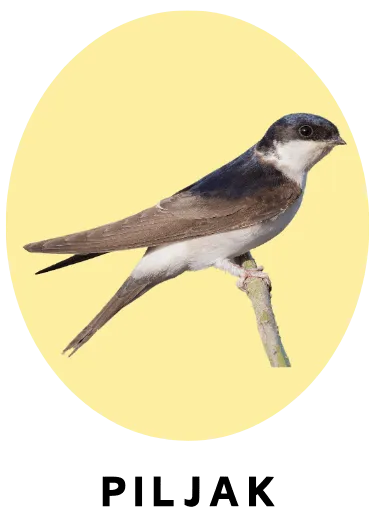
You can recognise a young house martin by its dark back, white rump and belly, white feathered legs and a wide beak with yellowish edges.
First steps: warmth, quiet and a call to a rescue centre
Never feed a cold chick – warm it up first.
- Put it in a cardboard box with air holes, lined with kitchen paper. Place a naked or sparsely feathered chick in a small container lined with paper, as a substitute nest. Do not use cotton wool.
- Put a hot-water bottle or a small bottle of warm, not boiling, water wrapped in a cloth next to it. Naked chicks need about 32 to 35 °C, feathered ones about 26 to 30 °C. Leave it room to move away from the heat if it gets too hot.
- Partly cover the box and keep it in a quiet, darkened room.
- Do not pour water into its beak, either with a dropper or a syringe. The chick can easily choke, and it gets its fluids from its food.
- Never keep it in a wire cage and do not let it fly freely around the flat. Damaged feathers can cost it its migration.
- House martins are social birds, and at rescue centres they are raised together with other house martins. That is another reason why it is important to contact a rescue centre as soon as possible. A list of contacts for associations and wildlife rescue centres is available on our website.
What do baby house martins eat?
In the wild, the house martin catches tiny flying insects: flies, gnats, small beetles, aphids and mosquitoes. That is why it eats insects only during rearing, too.
- Suitable: flies, small crickets, waxworm larvae, drone brood, freshly killed or thawed. For young chicks, cut larger insects into bite-sized pieces.
- Never: bread, milk, porridges and pastes, egg, seeds, cat or dog food, earthworms or live larvae.
- Avoid mealworms. Experienced swallow rehabilitators report that they impair feather quality in house martins.
- Farmed insects are less nutritious than wild ones, so rescue centres add vitamins, especially B complex, and minerals. Agree on which supplement to use and how much with a vet or a rescue centre.
How do you feed a baby house martin?
- Hold the chick in a natural position, on its belly or upright, never on its back.
- Feed with blunt tweezers. Place each bite deep in the throat, behind the opening of the windpipe, and wait for the chick to swallow.
- Feed roughly every 30 minutes, from dawn to dusk. There is no feeding at night. As the chick grows, the bites get bigger and the intervals a little longer.
- At first, young house martins often won't gape in front of people. Do not force the beak open if you have never done it before, because with such a tiny bird it is easy to injure the beak or choke it. In that case the chick is safer in the hands of a rescue centre.
- You can briefly dip the insects in water before feeding. This is the only safe way for the chick to get a little fluid.
I recommend weighing the chick regularly on kitchen scales and writing down its weight. A chick that isn't gaining weight needs expert help.
Cleanliness and health
For a house martin, clean feathers are a matter of survival. Remove droppings from the paper after every feed and change the bedding several times a day. Watery or unusual droppings are a reason to call the vet.
- Wash your hands before and after handling the chick, and boil the tweezers regularly.
- House martin nests are often home to mites and small parasitic flies. They are not dangerous to people, but they wear the chicks down, so have a vet take a look.
- Birds can carry bacteria such as salmonella. With basic hygiene, this is no reason for alarm.
- Do not cuddle the chick, and keep contact with people to a minimum so that it stays wild.
How does a young house martin learn to fly and hunt?
This is the hardest part of rearing and the reason why house martins should be handed over to a rescue centre. A house martin does not feed from a dish on the ground like a blackbird; it catches insects on the wing. Before release it must learn to catch live flies in a flight area, such as a soft mesh tent or a dedicated room. In rescue centres, young house martins practise together and learn from one another. A chick that was raised alone and has never hunted on the wing has very poor chances in the wild.
When can you release a house martin?
- A house martin is ready when it is fully feathered, takes off confidently from the ground and from a branch, controls its flight well and catches insects on its own. At rest, its wing tips should cross over its tail.
- Its weight should be close to that of an adult bird, roughly 16 to 18 grams.
- Release it in the morning, in warm, dry weather, in an open spot, into the wind and near a house martin colony, so that it can join the flock before the autumn migration.
- Never throw it into the air to see whether it can fly.
- A chick that isn't ready before migration has to overwinter in a rescue centre. This is definitely not a job to be done at home.
Conclusion
A young house martin on the ground almost always needs help, but the greatest help is quick and correct action: warmth before food, insects only, no water into the beak, and the fastest possible route to an experienced rescue centre. In Croatia, house martins and their nests are protected by law. Nests must not be removed, and long-term rearing and keeping of wild birds is permitted only for licensed rescue centres. The goal is always the same: for the house martin to fly away with the other swallows.