
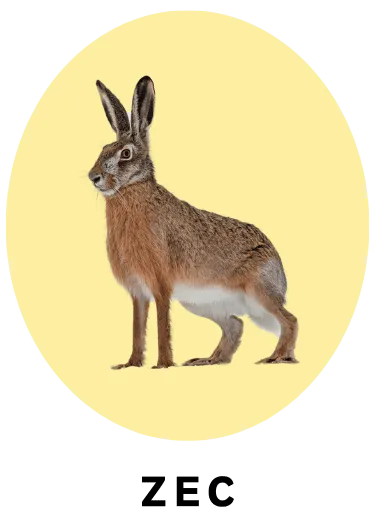
Raising a baby hare
Raising a baby hare: found a young hare? Most of the time it should be left alone
Every spring and summer, people get in touch with me after finding a baby hare lying quietly on its own in the grass, in a meadow or at the edge of a ploughed field, not running away. The first thought is almost always the same: the poor thing has been abandoned and needs rescuing. With the European hare (Lepus europaeus), the truth is almost always the opposite. Raising a baby hare is one of the hardest tasks of all with wild animals, so the greatest help you can give it is knowing when to leave it where it is.
Has the baby hare really been abandoned?
A doe hare does not live with her young in a burrow. Leverets are born fully developed: they have fur and open eyes and can soon move about. The mother leaves them in a shallow hollow in the grass and spends the whole day far away from them, so that her scent and presence do not attract a fox, a dog or a bird of prey. She comes back to her young only at dusk, briefly suckles them with very rich milk and leaves again. After just a few days the young scatter around the area and each one lies up on its own.
That is why a baby hare lying alone in a field is not an orphan. Its defence is to keep low and stay still. This is my advice:
- do not touch it, stroke it or take it home, not even “just to have a look at it”,
- quietly move away straight away and take children and dogs with you, because the mother will not come while you are nearby,
- if you want to be sure, check on it from a distance the next morning; if it is still in the same place and looks lively, all is well.
Help is needed only if the leveret is visibly injured (blood, dragging a leg, flies or maggots in its fur), if a cat or dog has brought it in, if it is lying cold and limp, if its mother is lying dead next to it, or if it is on a road or in front of a mower. If you just need to move it out of harm's way, wear gloves and carry it a few dozen metres to cover in the same meadow, in the direction it was facing.
Baby hare or young rabbit: how can you tell them apart?
A young hare and a young rabbit are easily confused, yet they have completely different needs.
- A young hare is born in the open, covered in thick brown fur, with its eyes open. Its ears are longer, and a pale amber ring can be seen around the pupil. It lies alone and does not run away.
- The European rabbit (Oryctolagus cuniculus) is born naked and blind in an underground burrow and stays there for about three weeks. A naked, blind rabbit outside its burrow almost certainly needs help. Older young rabbits have shorter ears and a more compact body, and when in danger they run for their burrow.
- A domestic rabbit is often patterned or white and is not afraid of people. A young rabbit like this is not a wild animal but someone's escaped or abandoned pet. Never release it into the wild; hand it over to an animal shelter or adopt it.
What should you do if a young hare really does need help?
If you are sure the leveret is injured or in immediate danger, act calmly and quickly:
- put on gloves and catch it by covering it with a towel; hold it in your hands as little as possible,
- put it in a cardboard box with air holes, lined with a towel or paper towels, and close the box,
- if it is cold, warm it up first: put a hot-water bottle wrapped in a towel under half of the box so that it can move away if it gets too hot,
- keep the box in a quiet, dark room, away from children, dogs, cats and noise,
- do not give it any food or water, and certainly no cow's milk,
- call a vet or a wildlife rescue centre straight away. A list of contacts for associations and rescue centres can be found on our website.
Young hares are extremely sensitive to stress. They can die of shock simply from being looked at, touched and moved around too much, even if they have no injury at all.
What do baby hares eat, and why shouldn't you feed one yourself?
In the wild, a baby hare gets very rich, nutritious milk from its mother, only once or twice a day. After about ten days it starts nibbling grass and plants around it, and at around four weeks it is fully weaned and feeds itself on grasses, clover and other herbaceous plants.
I know from experience that feeding is exactly where good intentions most often end in tragedy. A young hare's digestive system is extremely sensitive: the wrong milk, feeding too fast or a sudden change of food upset the gut flora and the animal dies, often only after a few days. Never give a young hare cow's milk. Rescue centres use special milk replacers and closely monitor weight, amounts and intervals between feeds, and advice from the internet cannot replace that.
If a vet or rescue centre asks you to look after the youngster briefly until help arrives, feed it only what they recommend and exactly as they tell you.
How are baby hares fed by experts?
To help you understand why this is not a job for beginners, here is what raising a baby hare looks like in a rescue centre:
- the youngster is fed slowly, drop by drop, while lying on its belly or standing, never on its back, because milk easily gets into the lungs and causes pneumonia,
- after each feed, very young leverets need a gentle massage of the tummy and genital area with damp cotton wool so that they urinate and defecate,
- from the very first days they are given fresh grass and wild plants so that their gut gradually adapts to plant food,
- contact with people is kept to an absolute minimum, because a hare that gets used to humans does not survive in the wild.
Even with all this, mortality among hand-reared hares is high, even in experienced hands. So I'll say it again: leave an uninjured young hare to its mother.
When is a hand-reared hare released into the wild?
A hare is returned to the wild once it is fully weaned, grazes on its own and has reached a weight and strength appropriate for its age. Release is gradual: first it stays in an outdoor enclosure, where it gets used to the weather, natural food and the sounds around it. It is released at dusk, in a quiet place with meadows and hedgerows, far from roads and settlements, preferably where other hares live.
In Croatia, the European hare is a game species and must not be kept at home as a pet. Decisions about a youngster that needs care should be left to a vet or rescue centre, who will also notify the holder of the hunting rights for that area if necessary.
Can people catch diseases from hares?
Hares can transmit tularaemia (rabbit fever), a bacterial disease that passes to humans through contact with an infected or dead animal, and they also carry ticks and fleas. The risk during brief care is small if you stick to simple rules: handle the hare only with gloves, don't touch your face while handling it, and wash your hands thoroughly with soap afterwards. If the animal scratches or bites you and you later develop a fever or swollen lymph nodes, see a doctor and tell them you have handled a wild hare.
Conclusion: the best help for a young hare is to leave it to its mother
A baby hare alone in the grass is almost never abandoned; it is waiting for its mother, who comes at dusk. Don't touch it, move away and put your dog back on the lead. It needs help only if it is injured, cold or in immediate danger – in that case warm it up, put it in a quiet box, give it nothing to eat and contact a vet or rescue centre straight away. Raising a baby hare is a job for experts, and your decision not to take it home is often exactly what saves its life.