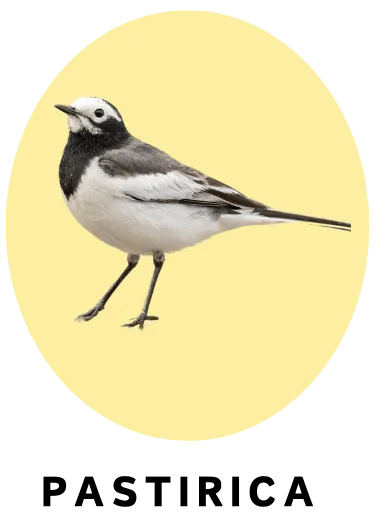
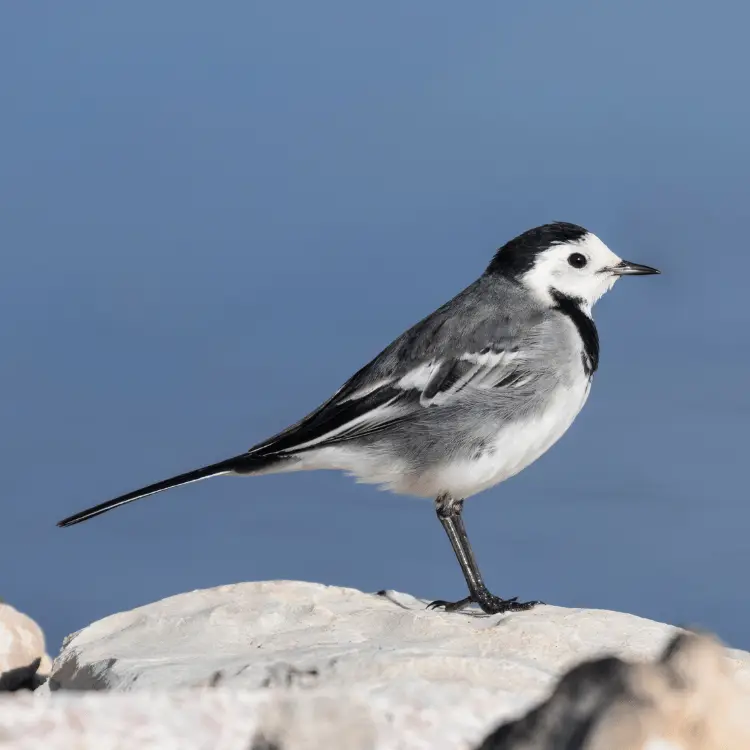
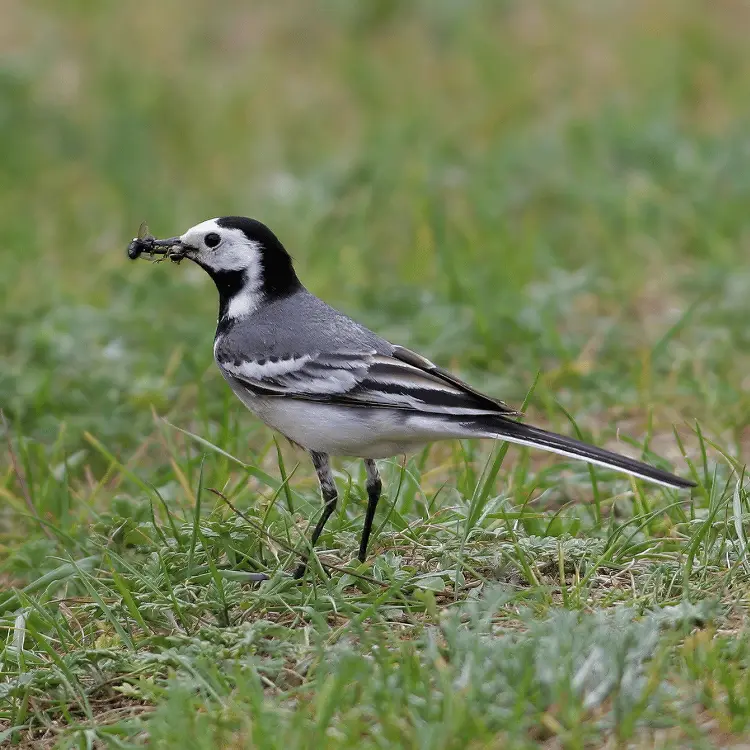
The white wagtail (Motacilla alba) is a distinctive, slender bird of the wagtail and pipit family (Motacillidae), known for its speed, its constantly wagging tail and its graceful running across open ground. It is often seen near water, in fields and even in towns, where it tirelessly hunts insects.
What does the white wagtail look like?
Its body length is 16–19 cm and its wingspan about 25–30 cm.
A slender body with a long tail that constantly flicks up and down.
The head is white with a black cap and black markings on the neck, giving it a distinctive look.
The plumage on the back can range from greyish to black, depending on the subspecies and the time of year.
The underside is always pale, usually white.
The legs are thin and long, adapted for running quickly along the ground.
White wagtail habitat and distribution
The white wagtail is widespread throughout Europe, Asia and North Africa, and in winter it migrates to warmer regions, including the Middle East and Africa.
It lives near rivers, lakes, marshes and streams, where it easily finds prey.
It is often seen in open fields, meadows and farmland.
It has also adapted to urban life, so it can be found in parks, on roads and on rooftops.
In Croatia it is common and can be seen all year round, especially in the south, such as Dalmatia, where some populations overwinter.
Diet and hunting technique
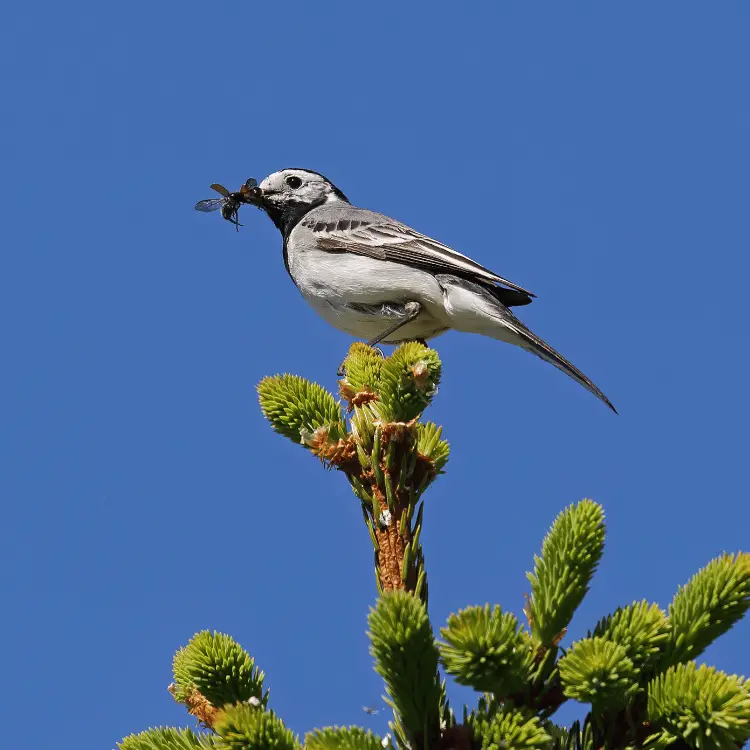
The white wagtail is an insectivorous bird, which means it feeds mainly on insects and other small invertebrates.
Its main prey are flies, mosquitoes, ants, spiders and small grasshoppers.
It runs quickly along the ground, stopping suddenly to snatch an insect.
It often hunts on damp ground, such as riverbanks and muddy meadows.
It can be seen following livestock, catching the insects the animals disturb as they walk.
Sometimes it flies low over the water, catching insects in mid-air.
Breeding and nesting
The breeding season lasts from April to July.
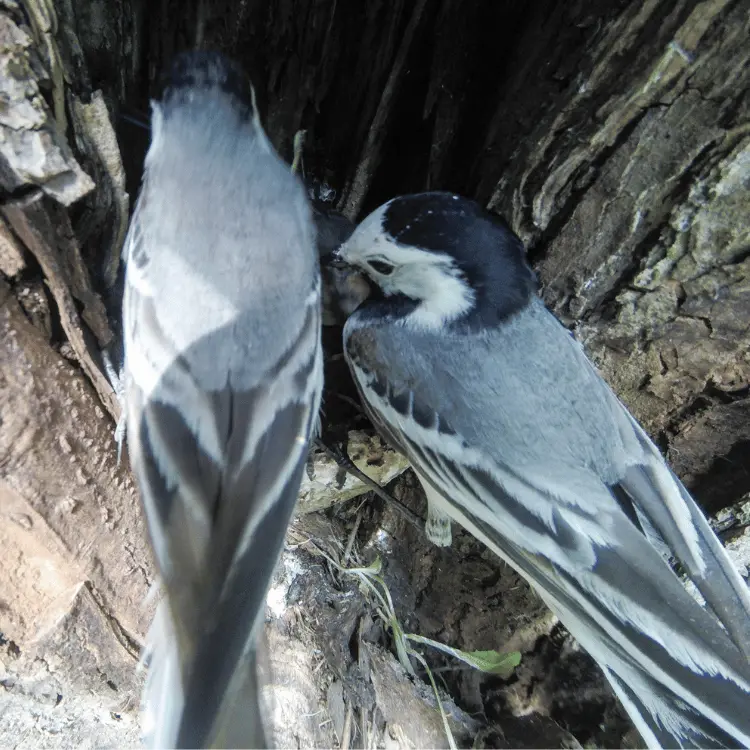
It builds its nest in sheltered spots, such as cracks in rocks, under bridges, in lofts or in abandoned buildings.
The female lays 4–6 eggs, which she incubates for about 12–14 days.
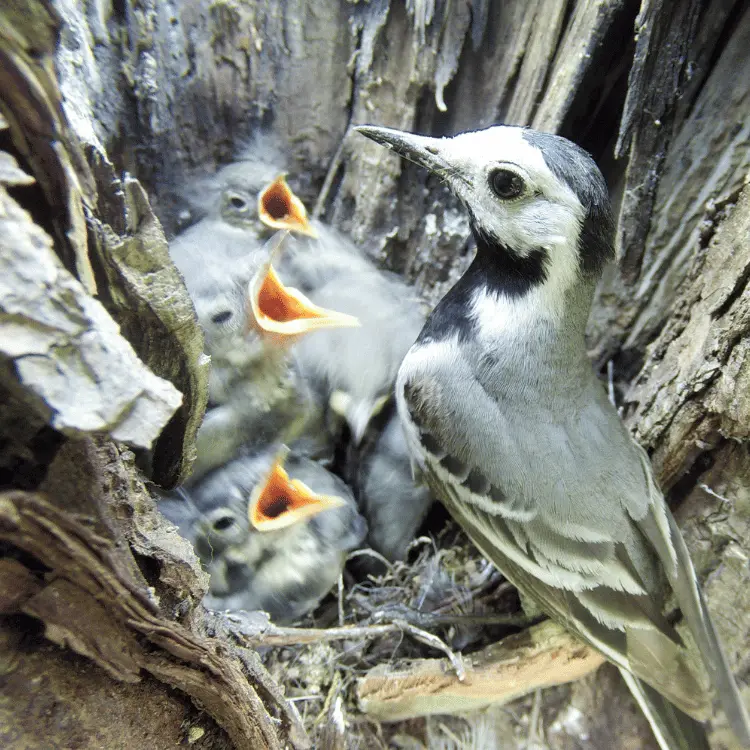
Both parents feed the young, which leave the nest after 14–16 days.
White wagtails often raise two broods a year, which keeps the population stable.
White wagtail behaviour
It is very active and almost never still, constantly wagging its tail and running about in search of food.
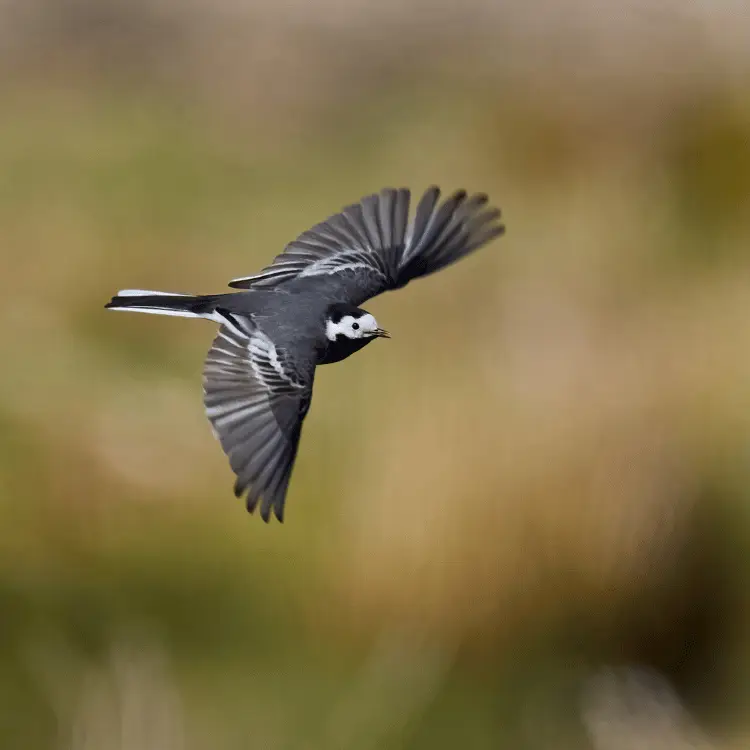
Its flight is fast and undulating, with short bursts of flapping and gliding.
It is fairly sociable and often forms small flocks outside the breeding season.
At night it gathers at communal roosts, where dozens or even hundreds of wagtails can be seen.
Nesting and caring for the young
The white wagtail’s breeding season runs from April to August, and during this time it may raise two or three broods. Wagtails are monogamous, and pairs often stay together for the whole breeding season.
The female lays 4–6 eggs, which are pale blue or white with dark speckles. Incubation takes 11–14 days, during which the female stays on the eggs while the male brings her food from time to time.
When they hatch, the chicks are helpless and naked, relying on their parents for food and warmth. Both parents work hard to feed them small insects and larvae, ensuring they grow and develop quickly.
The young stay in the nest for 10–16 days, after which they leave and start exploring their surroundings, but their parents continue to feed and guard them for a while. After two to three weeks, the young wagtails become fully independent and ready for life in the wild.
Threats and protection of the white wagtail
Although the white wagtail is not an endangered species, it does face certain challenges:
Habitat loss due to urbanisation and water pollution.
Declining insect populations, its main source of food.
Collisions with vehicles, as it often feeds along roads.
Destruction of nests in towns and cities, where it often nests close to people.
How can you help the white wagtail?
Conserving natural habitats and protecting riverbanks.
Reducing the use of pesticides, which lower insect numbers.
Putting up artificial nesting shelters on roofs and bridges, where it often nests.
Raising awareness of the importance of this bird in controlling insect populations.
Conclusion
The white wagtail (Motacilla alba) is an energetic, elegant and useful bird that adapts easily to different environments. Its presence in the countryside and in towns helps keep insect numbers in check, and its cheerful behaviour makes it a favourite sight for birdwatchers. Although it has successfully adapted to the modern world, conserving its natural habitats is key to its long-term survival.