
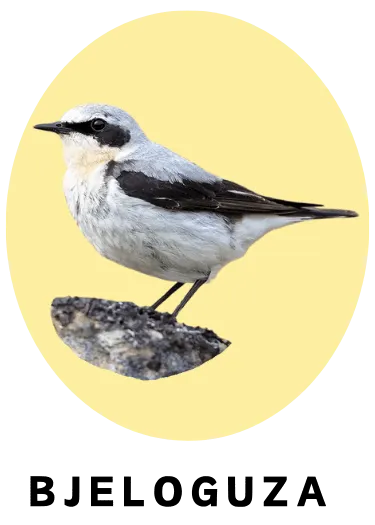
Raising a baby black-eared wheatear
You have found a baby black-eared wheatear
The western black-eared wheatear (Oenanthe hispanica), also known in Croatian as “bjeloguza prutka”, is a bird from the Old World flycatcher family (Muscicapidae). Raising this chick requires a specific diet and the right conditions to prepare it for an independent life in the wild.
Ideal housing conditions for a black-eared wheatear chick
Black-eared wheatears (Oenanthe hispanica) are birds that need a warm, safe and spacious enclosure while they are being hand-reared. Proper housing ensures healthy development, prevents stress and prepares the chick for an independent life.
. Temperature and heating
✅ Newly hatched chicks (0–7 days): 32–35°C
✅ Chicks 7–14 days: 30–32°C
✅ Chicks 14–21 days: 28–30°C
✅ Chicks older than 3 weeks: normal room temperature (24–26°C)
Use a heat mat (place it under the box, but make sure the chick can move away from the warm part).
You can use an infrared lamp, but never pointed directly at the chick – let it heat only one corner of the enclosure.
Type of housing
✅ Ideal option:
A smallish box or plastic pet carrier (with ventilation holes).
A soft towel or paper towels as bedding (change regularly).
Low sides so the chick can easily lift its head and open its beak.
🚫 Do not use:
Sawdust, sand or hay (can cause choking and irritation).
Wire or smooth surfaces (bad for the development of the legs).
Boxes that are too large (the chick may feel lost and frightened).
Keep the box in a quiet place, away from draughts, bright light and noise.
Avoid contact with other pets (cats, dogs and other birds can cause stress or injuries).
Loosely cover the box with gauze or netting to stop the chick escaping once it gets stronger, while still letting in enough air.
How often and how much should you feed it?
A black-eared wheatear's diet must be frequent and rich in protein, especially in the first weeks of life.
First 3–5 days: Every 20 minutes during the day (from dawn to dusk).
5–10 days old: Every 30 minutes.
10–15 days old: Every 45 minutes
15+ days: Every 1.5 hours, gradually reducing the frequency as the chick grows.
Black-eared wheatears do not eat at night, so no night feeds are needed.
✅ Amount of food per feed
Younger chicks: 2–3 small insects per feed
Older chicks: 4–5 insects per feed
Before fledging: 5–10 insects per feed
The chick must not be overfed – the beak must open naturally, without being forced.
What should you feed it?
Black-eared wheatears are insectivores, so they need a high-protein diet of live or dried insects.
✅ Ideal food:
Small grasshoppers and crickets (live or dried)
House flies and fruit flies (Drosophila)
Spiders and other soft-bodied insects
Minced insect larvae (mealworms, superworms – in moderation)
Special formulas for insectivorous birds (available in specialist shops)
🚫 What it must not eat:
Seeds and fruit (black-eared wheatears cannot digest them properly)
Bread, milk and oats (can cause digestive problems)
Raw meat (an unnatural food for this species)
How to feed the chick
Offer food with tweezers
Imitate pecking movements by gently touching the food against the edge of the beak.
Feed it in a natural position (the chick must be upright).
Never push food too deep into the beak, to avoid choking.
Gradually getting used to a larger space
As the chick grows and gets stronger, it needs more space to practise flying and to explore.
✅ Move it to a bigger box or a small aviary after 2–3 weeks.
✅ Put in thin twigs so the chick learns to perch and balance.
✅ Provide a space with natural light, but not in direct sun (risk of overheating).
Preparing for release into the wild
Once the chick starts eating on its own, move it to an aviary or a larger outdoor cage.
Black-eared wheatears are territorial and migratory, so it is important that the hand-reared chick is properly prepared for its return to the wild.
✅ Key steps:
Towards the end of hand-rearing, the chick needs a safe outdoor space where it can learn to fly and catch insects.
Gradually reduce contact with people: To reduce its dependence on humans, limit direct contact except during feeding.
Simulated hunting: You can release live flies or small insects into the aviary so the chick learns to hunt on its own.
Gradual release: Once the chick flies steadily and eats on its own, it can be released on a warm day, in the morning, at a site with enough food and shelter.