
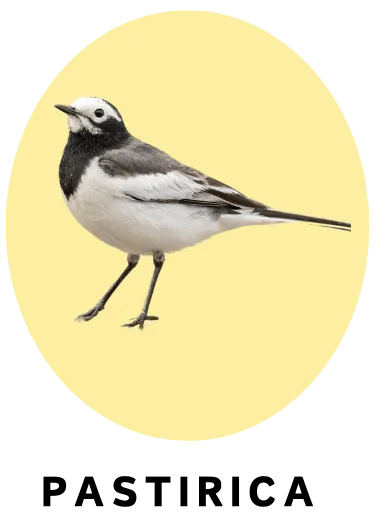
Raising a baby white wagtail
How to raise a white wagtail chick
The white wagtail (Motacilla alba) belongs to the family Motacillidae and is often found along rivers and in meadows and fields. Although it is a fairly independent bird, young wagtails may need help to survive and grow into healthy birds that can fly and survive in the wild. Below is a detailed guide on how to raise a wagtail chick properly, give it the best possible housing and prepare it for its return to the wild.
Ideal housing for a wagtail chick
To give the chick a safe and comfortable space, it is essential to replicate natural conditions. White wagtails usually live on grassy areas and in the surroundings of rivers and lakes, so it is important to give them housing that allows them to move about and rest.
Cage housing – the chick needs a spacious cage in which it can move around. The minimum cage size is about 50x50x50 cm; of course, a larger cage always provides more room for natural behaviour.
Ventilation and safety – the cage should be kept in a quiet place, away from other pets and noise. Also make sure the cage has adequate ventilation openings and that the chick feels safe inside it.
Cage lining – use paper lining or bamboo granules, which let the chick move about and rest easily, but avoid dusty materials.
Heating – if the chick is younger, it is important to keep conditions warmer. The ideal temperature for young chicks is between 28 and 32°C, which you can achieve with a hot-water bottle or an infrared lamp. As the chick grows, the temperature can be gradually lowered according to its age.
The right diet for a wagtail chick
Wagtails are insectivorous birds, which means that in the wild they feed on insects, spiders and larvae. The right diet is key to their recovery and health.
Live insects – the best option for feeding a wagtail chick is small insects such as small flies, mosquitoes, grasshoppers, worms and spiders. You can buy these insects in specialist pet shops or collect them outdoors.
Insect substitute – if you can't get live insects, you can use dried worms or a food mix for insectivorous birds.
Substitute meals – in the early stages you can offer the chick mashed hard-boiled egg (in very small amounts) as a supplement, although insects should make up the main diet.
How to feed the chick
Tweezers or syringe – for feeding you can use tweezers to guide the insects into the chick's beak. At first you may need to feed the chick with a syringe with a small opening, which makes precise feeding easier.
Feeding frequency – very young chicks (up to 7 days) should be fed every 2 hours during the day, while older chicks can eat every 3 hours.
Amount of food – per feed, the chick should eat 2 small flies or half a teaspoon of food. Gradually increase the amount as the chick grows and gets stronger.
Preparing the chick for its return to the wild
Once the chick is strong and independent enough, it is time to prepare it for its return to the wild. Gradually removing its dependence on people and providing natural conditions are vital for a successful recovery.
Gradually reducing contact – so that the chick becomes as independent as possible, gradually reduce its contact with people. Too much dependence on people can hamper its ability to cope in the wild.
Preparing for flight – to prepare the chick for its return to the wild, give it room to fly. Put branches, shrubs and safe landing spots inside the enclosure.
Simulating hunting – if the chick has not started catching insects yet, release insects in natural conditions so that it can practise catching them.
Reduce the frequency of hand-feeding so that the chick learns to hunt and feed itself. This should be done gradually to ensure the transition to a fully independent life.
Gradually reducing food will help the chick break free of human help and develop the ability to survive in the wild. Start reducing the amount of food when the chick begins to show signs of feeding itself, but make sure the process is gradual and careful.
Release into the Wild
Release site:
Open grassland, farmland, meadows by water, riverbanks or even city parks with low vegetation.
Ideally an area with plenty of insects, as the wagtail feeds on insects that it catches in flight or on the ground.
Release time:
Best early in the morning, when it is calm and there is plenty of food.
No rain or strong wind, because a young wagtail needs time to adapt to its surroundings.
Before release, check that it can catch food on its own and has good stamina in flight. If it tires quickly or seeks out people for food, it may not be ready yet.
Conclusion
Hand-rearing a white wagtail chick (Motacilla alba) requires a lot of attention, patience and the right conditions. The best possible diet, proper housing, heating and a gradual transition to wild conditions are key to a successful recovery and return to the wild. If you follow all these guidelines, the wagtail chick will be ready for an independent life in the wild, where it will catch insects and carry on with its natural behaviour