
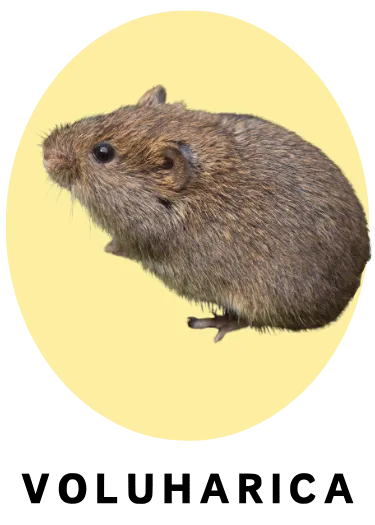
Raising a baby vole
Raising a baby vole: have you found a young vole?
We most often find baby voles when a mower or hoe uncovers a nest in the grass, or when a cat brings them to our doorstep. Although voles are among the most common mammals of our meadows and woods, hand-rearing a baby vole is very demanding because the young are tiny, weighing only a few grams. In this article I explain how to tell whether a baby needs help, what young voles eat and how to prepare them for their return to the wild.
Does a young vole really need help?
A vole with thick fur and open eyes that runs quickly and hides is already independent. Young voles become independent extremely quickly, at about three weeks, so at that age we often see them on their own. Leave such a little animal alone.
A baby needs help if it is:
- hairless or has its eyes closed and is outside the nest,
- cold, limp, wobbly on its feet or has a bloated tummy,
- injured, or covered in flies or parasites,
- has been in the mouth of a cat or dog, even if you can’t see a wound.
If you have only uncovered the nest and the young are warm and unhurt, put the nest back as it was, cover it with grass and move away, keeping pets at a distance. The mother often moves the young one by one, so do not touch them straight away. If she has not come back after three hours, the babies need help.
First steps: warmth above all
Baby voles lose heat within a few minutes. Never feed or give water to a chilled vole; first warm it up slowly to body temperature.
- Put it in a small box with soft fabric that does not fray, or with dry grass.
- Place a heat source, such as a bottle of warm water wrapped in a towel, under or beside half of the box so that the baby can move away from it.
- Cover the box and put it in a dark, quiet place. Do not stroke it or keep checking on it.
Take a vole that has been caught by a cat to a vet straight away, because even an invisible scratch from a cat’s teeth can cause a serious infection. In all other cases, call a wildlife rescue centre or a vet as soon as the baby is warm. A list of associations and rescue centres is available on our website.
What do young voles eat?
Cow’s milk is out of the question, as is tea or sugar water as the only food. Babies that are still suckling need milk replacer for kittens, which is the most commonly used formula for small rodents. Agree on the exact formula with a vet or a rescue centre and do not change it along the way, because a sudden change in such small animals can cause fatal digestive problems.
- Until their eyes open (at about 8 to 10 days) the babies drink only milk.
- After their eyes open offer them rolled oats soaked in milk, and then fresh greens: dandelion, clover, chickweed and young grass.
- At two and a half to three weeks most eat on their own; now add cereals, seeds, and small pieces of carrot and apple.
Voles are mainly herbivores, so greens must be part of their daily menu. Pick greens away from roads and areas treated with pesticides.
How to feed a baby vole?
For such tiny babies, a syringe is often too big. Experienced carers use a thin pipette and put the milk on the tip of a soft paintbrush for the baby to lick. The milk must be warmed to body temperature.
- Hold the baby on its tummy, never on its back, because milk can easily get into the lungs.
- Give it drop by drop, let it lick and swallow by itself, and stop feeding as soon as milk comes out of its nose.
- Babies with closed eyes are fed every two to three hours during the day and every three to four hours at night.
- Once their eyes are open, night feeds are gradually spaced further apart.
Be honest with yourself: babies whose eyes are still closed have a slim chance of survival even in experienced hands. That is why I advise handing them over to a wildlife rescue centre as soon as possible rather than trying it yourself out of good will.
Hygiene and stimulating digestion
After every feed, gently massage the tummy and the area around the genitals and anus with a damp cotton bud or a small piece of cotton wool, using circular movements, until the baby urinates and defecates. Without this its digestion stops and its tummy becomes bloated. Keep doing this until it starts eating on its own.
Wipe milk off its fur straight away, change the bedding every day, and wash the feeding equipment after every feed and pour hot water over it.
When to release a vole into the wild?
When a vole eats only solid food, has glossy fur and is afraid of your hand, it is ready to go back. This is usually at four to five weeks. Keeping it longer serves no purpose and only makes it harder for it to adapt.
- Release it as close as possible to where it was found, at the edge of a meadow, by a hedge or shrubs, where it has cover and food.
- It is best to do this in the early evening, in dry, warm weather.
- Leave a small box with dry grass and a little food at the spot so that it has shelter for the first few days.
Handle it as little as possible during hand-rearing so that it does not lose its natural fear of people and predators.
Diseases voles can transmit
Small rodents can pass diseases on to people. In continental Croatia, rodents – including the bank vole – carry hantaviruses, which cause haemorrhagic fever with renal syndrome (“mouse fever”). Rodents can also transmit leptospirosis and tularaemia. So remember:
- only ever handle a vole wearing gloves,
- do not breathe in dust from its box; dampen the bedding slightly before cleaning,
- wash your hands thoroughly after every contact,
- if you develop a high temperature after contact, see a doctor and tell them you have been in contact with a rodent.
Wild animals in Croatia are protected by law, and some species, such as the Balkan snow vole, are strictly protected. Long-term hand-rearing and keeping are only permitted for a wildlife rescue centre or with a permit.
Conclusion
Raising a baby vole is short but intense: warmth before food, milk replacer instead of cow’s milk, feeding on its tummy and a gentle massage after every feed. With the help of a rescue centre and a little luck, in just a few weeks the little vole will be foraging for greens in its meadow again.