
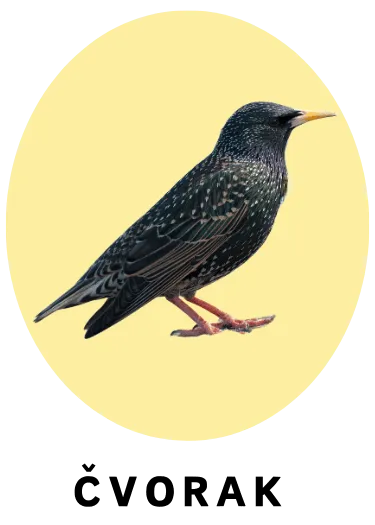
Raising a baby starling
How to hand-rear a starling properly
Finding an abandoned or injured young starling calls for special care to ensure its survival and successful return to the wild. It is important to give it the right diet, suitable housing and gradual adaptation to life in the wild.
Assessing its condition and housing
If the chick is cold, disoriented or visibly weak, it first needs to be warmed up. The ideal temperature for a young starling is about 35–37°C, which can be achieved with a hot-water bottle, a heat lamp or bottles of warm water wrapped in a cloth. Put the chick in a calm, safe place, such as a cardboard box with soft bedding, avoiding loud noises and unnecessary disturbance.
Diet – what and how to feed?
Starlings are omnivores, which means their diet must be varied and nutritious. In the early stage of hand-rearing, the most suitable mixture consists of:
Insects and protein food – mealworms, crickets, larvae, superworms (Zophobas), and finely chopped chicken hearts cut into strips (just dipped in water) and chicken.
Fruit and vegetables – apples, pears, berries and cooked vegetables such as carrots.
Supplements – a little probiotic for birds and vitamin and mineral supplements to strengthen the body.
The food is offered with tweezers, taking care not to put it too deep into the beak to avoid choking.
How often to feed depends on the chick’s age:
Very young chicks (with down still visible) need food every 2 hours.
Older chicks (feathered but not yet independent) eat every 3 hours.
When the chick starts pecking at food on its own, meals are reduced and it gradually moves on to solid food.
Water is not given directly; the chick gets the fluids it needs from its food until it learns to drink on its own.
Preparing for release into the wild
To prepare a starling successfully for its return to the wild, it is essential to give it space to fly and exercise. Once it becomes active and starts hopping around, it is ideal to move it to a larger cage or aviary with branches so that it develops the muscles it needs for flight.
It should be gradually introduced to its natural diet – offer it insects, fruit and seeds so that it gets used to what it will find in the wild. It is also important that the chick does not become too attached to people, as this could reduce its chances of survival in the wild.
Release into the wild
When the starling is fully independent in feeding and flying, it can be released in a safe area rich in food and cover, away from roads and predators. Ideally, release it near other starlings so that it can join a flock more easily and improve its chances of survival.
Proper hand-rearing and rehabilitation are key to a starling’s future in the wild. Patience, the right diet and gradual preparation will allow it to become strong and ready for life in its natural environment