
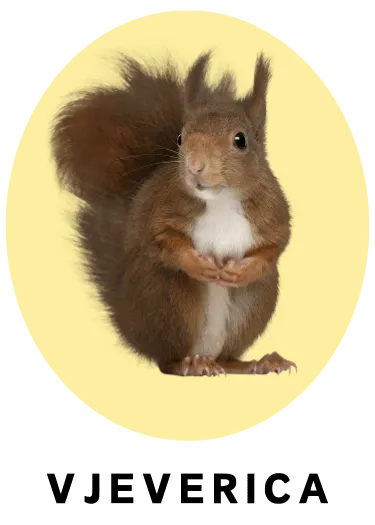
Raising a baby squirrel
Raising a baby squirrel: what to do if you find a young squirrel
Young squirrels are most often found in spring and late summer, when they fall out of the nest after a storm or when a tree is felled. Hand-rearing a baby squirrel takes about three months and requires a lot of knowledge, so the most important thing is to do the right thing in the first few hours. Our red squirrel (Sciurus vulgaris) is the only squirrel in Croatian forests. Below I describe when to help, what baby squirrels eat and how to prepare them for life in the wild.
Is the baby squirrel really an orphan?
A mother squirrel very often comes back for a baby that has fallen out of the nest and carries it to safety in her mouth. Human scent does not bother her. So the first task is to try to reunite the baby with its mother:
- if it is cold, warm it up first, because the mother often won’t take back a chilled baby,
- put it in an open box with a soft cloth and a warm bottle at the foot of the tree where it was found,
- move away, take dogs and children with you, and watch from a distance for at least one to three hours.
Help is needed if the mother does not appear, if the baby is injured, thin or covered in flies, if there is a dead female nearby, or if it has been attacked by a cat. A young squirrel that comes up to you and climbs up your legs is not being aggressive – it is desperately hungry and needs help.
First steps: warmth, quiet and an expert
Never feed a cold squirrel. It needs to be warmed up first, because a chilled baby cannot digest food. Put it in a box with air holes, in a nest made of flannel or an old woollen hat, with a bottle of warm (not hot) water well wrapped in a towel. Keep the box in a quiet room free from draughts.
As soon as it is warm, call a vet or a wildlife rescue centre. Young squirrels are almost always dehydrated, and fluids should be given according to an expert’s instructions. A list of associations and rescue centres is available on our website. I’ve learned from experience that it is a good idea to go back to where you found it and check whether there are any more babies from the same nest.
What do baby squirrels eat?
Cow’s milk is dangerous for young squirrels and can kill them. Squirrel rescue centres use powdered milk replacer for kittens or puppies; agree with a vet or rescue centre on which formula is best and how to dilute it.
- Until its eyes open (at about four to five weeks) the baby drinks only milk.
- From the sixth week offer it small pieces of apple and carrot, sunflower seeds and cracked walnuts and hazelnuts.
- From the seventh week add twigs with buds, wild fruits, pine cones and berries.
- At around ten weeks give it whole walnuts and hazelnuts in their shells so that it learns to open them and wear down its ever-growing teeth.
Do not stop the milk too early: squirrels need it until about ten to twelve weeks, otherwise they risk weak bones. Do not give them peanuts or bitter almonds.
How to feed a baby squirrel?
Warm the milk to body temperature and test it on your wrist. Feed the baby from a small needle-free syringe with a soft tip while the squirrel is lying on its tummy or sitting upright, never on its back. Press the plunger very gently, drop by drop, and pause now and then to let the baby catch its breath. If milk comes out of its nose, stop and tilt it head down, because milk in the lungs causes pneumonia.
As a rough guide, the amount per feed is about one twentieth of its body weight, and the intervals between feeds depend on its age:
- first and second week: every two to three hours, including at night,
- third week: every three hours, every four at night,
- fourth and fifth week: every three to four hours,
- from the sixth week about four feeds a day, alongside solid food.
Never feed a baby with a bloated, hard tummy; this is an emergency for the vet.
Hygiene and tummy massage
Until about the fifth week, young squirrels cannot urinate or defecate on their own. Before and after every feed, gently massage their tummy and genitals with a soft, damp, lukewarm cotton pad until they go. Kitchen paper is not a good choice because it damages their delicate skin.
After a feed, wipe the milk off its nose and fur, and change the bedding every day.
How does a young squirrel become independent?
Once it opens its eyes and starts eating on its own, the squirrel needs more and more space to climb and jump. A large cage with branches, and later an outdoor aviary, strengthens its muscles and teaches it agility. Line the bottom of the cage with something soft, as youngsters often fall.
Squirrels grow up best with others of the same age, from whom they learn the behaviour they need to survive, so rescue centres are happy to put lone babies together. Once it no longer drinks milk, stop handling it and limit contact: a squirrel that is not afraid of people and dogs will not survive long in the wild.
When to release a squirrel into the wild?
A squirrel is ready for freedom when it is fully weaned, strong, opens walnuts and hazelnuts by itself, and it is not too late in the year. This is usually at fourteen to sixteen weeks. A gradual (soft) release is best:
- place the aviary or a large cage with a nest box in a quiet spot next to woodland or a garden with old deciduous trees, away from busy roads, dogs and cats,
- the squirrel spends a few days getting used to the sounds and smells of its surroundings,
- one fine morning, open the door and leave it open,
- keep putting out food and water for at least a week, and longer if it keeps coming back.
Diseases and the law
Squirrels rarely pass diseases on to people, but they can have fleas and ticks, and older youngsters can scratch and bite. After the tenth week, wear gloves, and always wash your hands after caring for it. Have a deep bite looked at by a doctor.
Wild animals in Croatia are protected by law. You may not keep a squirrel as a pet, and long-term hand-rearing is only permitted for a wildlife rescue centre or with a permit.
Conclusion
Raising a baby squirrel starts with trying to reunite it with its mother and continues with warmth, the right milk, feeding on its tummy and patiently getting it used to freedom. Once it disappears into the treetops and doesn’t come back for food, you will know you have succeeded.