
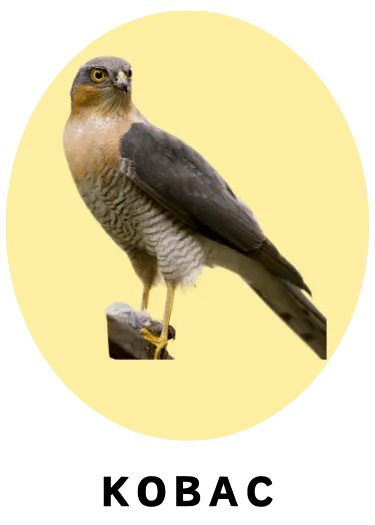
Raising a baby sparrowhawk
How to raise a young sparrowhawk
Finding a young sparrowhawk calls for special attention and expert guidance to ensure it develops properly and successfully returns to the wild. This guide gives detailed information on diet, housing, care and preparation for an independent life.
First steps after finding a duckling
If you have found a young sparrowhawk, it is crucial to assess its condition. If it is injured, malnourished or exhausted, it needs urgent veterinary help. If it has simply fallen out of the nest, it is important to give it the right diet, the best possible housing conditions and gradual preparation for the wild.
Ideal housing conditions
A young sparrowhawk should be kept in a quiet, warm and safe place, away from pets and noise.
Temperature: If it is very young and has no feathers yet, it needs to be kept warm. The ideal temperature for chicks still in down is 32–35°C. Use a heat mat or a heat lamp, but make sure the chick can move away from the heat source if it gets too hot. For the first few days it can stay in a soft nest made of cotton cloths, and later in a more spacious box or cage with natural branches. Avoid wire floors, as they can damage its feet.
It must be neither too dry nor too humid. The ideal humidity is around 50–60%. Give it a natural cycle of light and dark, but chicks must not be exposed to direct sunlight without access to shade.
Diet of a young sparrowhawk
Sparrowhawks are strict carnivores, so their diet is key to healthy development. Never feed them seeds, bread, milk or water from a syringe, as this can be fatal.
What and how to feed?
The basis of the diet should be fresh raw meat from birds or small mammals, and as it grows it should gradually be taught to eat whole prey.
Best food sources: raw chicken hearts, day-old chicks, quail, mice, pieces of game meat (without spices or salt).
Avoid: pork, fish, cooked meat and commercial cat or dog food.
How to feed:
Very small chicks must be hand-fed meat purée with tweezers or a syringe.
Older chicks can accept small pieces of meat with feathers or fur.
Almost fully grown young birds should learn to tear up food themselves and start eating whole prey.
Feeding frequency:
In down (up to 10 days old): every 2–3 hours, including at night.
Chicks (10–20 days): every 4 hours, with longer breaks possible at night.
Older chicks (3–5 weeks): 3–4 meals a day.
Before release (5+ weeks): 2 meals a day, with human interaction gradually reduced.
Amount of food:
Very young chicks: roughly 10–15% of body weight per day.
Almost fully grown young birds: can eat 20–30% of their body weight per day, which is equivalent to one whole small mouse or one day-old chick.
Supplements:
Calcium (crushed bones, pieces of cartilage, calcium powder for birds).
Vitamins (B complex, vitamin E).
Digestive enzymes (for better absorption of nutrients).
Whether to add digestive enzymes depends on the form in which you use them and on the diet you give the young sparrowhawk. If the chick gets whole prey (mice, quail, day-old chicks), the enzymes are already naturally present and you do not need to add any. However, if it is fed pieces of meat, it can be helpful to add enzymes in the following ways:
The best way to add digestive enzymes is to include the internal organs of the prey, such as:
Liver – rich in enzymes and vitamins.
Stomach and intestines of the prey – a natural source of digestive juices.
Heart and lungs – contain the enzymes and coenzymes needed for metabolism.
Simply add small amounts of these organs to a meal of meat to improve digestion and nutrient intake.
If you use enzymes as a supplement, here is how to add them correctly:
Use enzymes intended for birds of prey or cats, as they have similar needs.
The powder can be sprinkled on the meat – a small amount (a pinch) spread evenly over the pieces of food.
Diluting in water – some enzymes can be dissolved in a few drops of water and dripped onto the food before feeding.
Although it is not the primary method, lightly fermented raw pieces of meat can be used in some cases, as fermentation releases enzymes that aid digestion.
How often should they be added?
If natural prey is used (mice, quail, chicks) – enzymes are not needed.
If filleted meat without internal organs is used, enzymes should be added to every meal or every other meal.
If the chick has digestive problems (poor absorption, diarrhoea, slow growth), enzymes can be given with every meal until its condition improves.
If you decide on powdered enzymes, it is best to use minimal amounts and introduce them gradually so you can monitor the chick’s reaction
Preparing for the return to the wild
As the sparrowhawk grows, human contact needs to be reduced so it can develop its natural instincts.
Hunting training: Give it access to live prey under controlled conditions (e.g. mice) so it learns to catch food by itself.
Flight and muscle building: After week 5 it should be in a spacious aviary where it can practise flying and strengthen its muscles.
Minimal contact with people: As little touching and interaction as possible to avoid imprinting (bonding with humans).
Releasing it safely into the wild
Release must be gradual and in the right place. Ideally, the sparrowhawk should be released in an area with enough food and shelter and without too many predators.
When to release: at 6–8 weeks of age, when it can hunt and fly confidently.
How to release: Gradually – first into a semi-open aviary where it can explore on its own, and then into complete freedom. If possible, leave food nearby for the first few days until it has adapted.
Conclusion
Raising a young sparrowhawk takes a lot of knowledge, patience and the right approach. A proper diet, suitable housing and gradual preparation for the wild are key to its survival. If you are unsure about any step, it is best to consult wild bird experts to ensure the best possible care and chance of a successful return to the wild