
Raising a baby lark
How to raise a lark chick
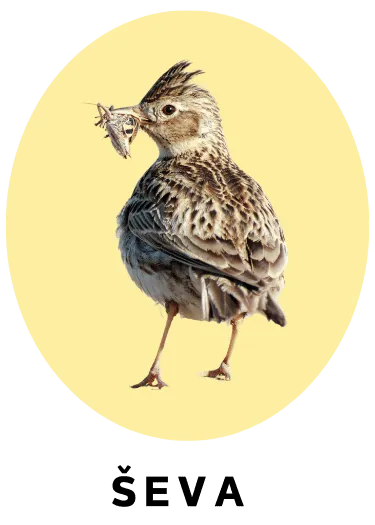
The crested lark (Galerida cristata) belongs to the lark family, Alaudidae, and can be found in dry, open areas such as fields and meadows. Like many other bird species, young larks may need help in the first few weeks of life to survive and grow into healthy, independent birds. Below is a detailed guide on how to raise a lark chick properly, give it the best possible housing and prepare it for its return to the wild.
Ideal housing for a lark chick
For a lark chick to develop successfully, it is important to give it a safe and comfortable place that replicates natural conditions. Larks are birds that usually live in open spaces, so housing inside the cage is vitally important.
Cage and space to move
A spacious cage – a lark needs enough room to move around. The ideal cage size for a young chick would be about 50x50x50 cm, but a wider cage always gives the chick more freedom.
Put the cage in a quiet, safe place, away from noise and other pets. The room temperature should be between 20 and 25°C, and the cage should be positioned so that the chick gets enough natural light.
Cage lining – use bamboo granules or paper lining, as they are hygienic and make it easier for the chick to move about.
Heating and temperature
If the chick is younger and warmer conditions are needed, use a hot-water bottle or an infrared lamp to maintain the temperature in the cage. The recommended temperature for very young chicks is between 28 and 32°C; the temperature can be lowered as the chick grows and becomes more independent.
Warmth is very important for young chicks, because a lack of warmth can slow their growth and development.
The right diet for a lark chick
A lark chick's diet is very specific, because in the wild this bird forages on the ground and feeds on various kinds of seeds, insects and small invertebrates. For a successful recovery, you need to provide suitable food and feed the chick according to its needs.
Types of food for a lark chick
Insects – live insects are the best option for feeding a lark chick. You can use small flies, grasshoppers, worms and spiders. You can buy these insects in specialist pet shops, and you can also collect them outdoors.
Seeds – if you can't get insects, you can start feeding the chick seeds such as millet, sunflower seeds and oat flakes. You can grind the seeds into a powder, mix them with water and offer them to the chick, or feed it hand-rearing formula.
Mashed egg – mashed hard-boiled egg can be used as a supplement, but insects should be the main source of food.
How to feed the chick
Tweezers or syringe – you can feed the chick using tweezers for insects or a syringe, which allows precise feeding. At first, use a syringe to help it take in the amount of food it needs.
Feeding frequency – younger chicks should be fed every 2 hours during the day. Older chicks can eat every 3 hours, and the number of meals per day decreases as the chick becomes more independent.
Amount of food – per feed, the chick should eat 2 small flies or half a teaspoon of food, depending on its age and appetite. As the chick grows, the amount of food will increase.
Preparing a lark chick for its return to the wild
Once the chick is strong enough, it is important to prepare it for an independent life in the wild. This includes reducing its dependence on people and training it to survive in natural conditions
Gradually reduce contact with people so that the chick becomes more independent and learns to cope in the wild.
Make sure it does not become dependent on people for food and attention.
Reduce the frequency of hand-feeding so that the chick starts catching insects on its own. This process should be gradual, because chicks need time to adapt to hunting and surviving on their own.
Reducing hand-feeding while increasing independent feeding will help the chick learn how to survive without human help.
Release into the Wild
Release site:
Dry, sandy or rocky areas with low vegetation (meadows, fields, uncultivated pastures, maquis).
Road embankments, the edges of farm tracks or uncultivated parts of farmland, as larks often spend time in such places.
Release time:
Morning or late afternoon, so that it has time to adapt before evening.
In settled weather, without rain or strong wind, because it relies on the ground for moving about and feeding.
Before release, check whether it can hop about on its own, look for food on the ground and fly well. It is best to release it in a place where there are other larks, so that it can blend into its natural environment more easily
Conclusion
Hand-rearing a crested lark chick (Galerida cristata) requires careful management of its housing, feeding and preparation for life in the wild. With the right diet, safety and a gradual reduction in human contact, the chick will develop the skills it needs and be ready to return to the wild. By providing these conditions, you give the chick the best chance of recovery and an independent life