
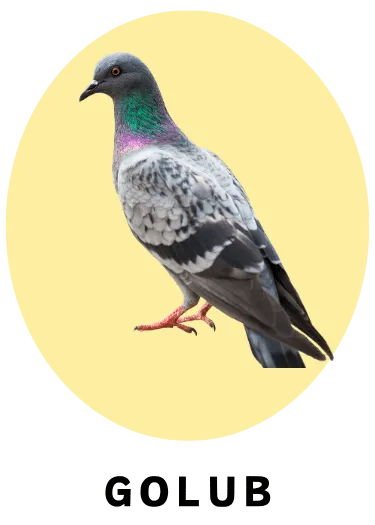
Raising a baby pigeon
Hand-Rearing a Young Pigeon: Until Its Return to the Wild
Pigeons are intelligent and adaptable birds, but the chicks depend entirely on their parents for the first few weeks of life. If you find a baby pigeon that needs help, it is important to know how to raise it properly and prepare it for an independent life.
First steps after finding a duckling
If you come across an abandoned squab, first assess its condition:
If it is cold and exhausted – It needs warming up straight away: put it in a soft box lined with cloth, and you can place a bottle of warm water (wrapped in a cloth) underneath.
If it has visible injuries – It needs a vet’s help.
If it looks healthy but is alone – It may have fallen out of the nest. If it cannot be returned to its parents, you are taking on the responsibility of raising it.
A squab needs a calm, safe environment, free from stress and direct sunlight.
Diet: What do baby pigeons eat?
In the wild, pigeon chicks are fed “crop milk” – a nutritious fluid produced by their parents. When hand-rearing them, we need to imitate this natural way of feeding.
The first days: hand-rearing formula and syringe feeding
In the first days of life, a squab needs easily digestible food:
Hand-rearing formula for chicks – A special formula for hand-feeding (available from pet shops).
Preparing the mash – The formula is mixed with warm water until it becomes a smooth, runny mixture.
Feeding with a large syringe – A glove finger with a hole cut in it is attached to the tip of the syringe so the squab can insert its beak, imitating the natural way of feeding.
Feed every 2–3 hours, taking care not to overfill the squab. DO NOT FEED AT NIGHT.
Diet from a few days old until it feeds itself
As the squab grows, it moves on to thicker food:
Ground seeds (80%) and puppy kibble for toy breeds (20%) – Soak the kibble in water beforehand until soft. It is needed for the protein required for development.
The mixture is blended into a mash and given with the syringe and glove, just as with the earlier feeds.
As the bird gets stronger, the mash is gradually thickened, and in time whole seeds can be added.
At this stage, feed 3–4 times a day.
Preparing for independence
As the squab develops, it needs to get used to solid food and become independent:
Leave it a dish of seeds so it starts pecking at food by itself. Tap the seeds with your finger to show it what to do. Give it space to fly, because physical activity is key to building its muscles.
Reduce interaction with people to prepare it for its return to the wild.
Release into the wild
The pigeon is ready for release when:
It eats seeds and drinks water on its own.
It has fully developed feathers and can fly confidently.
It is not too attached to people.
It is best to release it in an area where other pigeons already live, so it can adapt more easily and find a mate.
Conclusion
Raising a young pigeon takes patience, the right diet and gradual independence. With the right approach, you give it the chance to grow up healthy and return successfully to the wild, where it can carry on its natural life.