
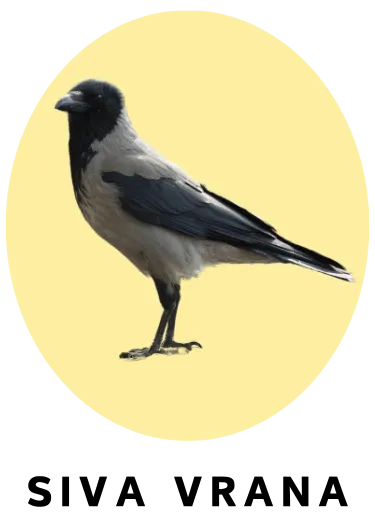
Raising a baby hooded crow
How to Care for a Hooded Crow Chick Properly
If you have found a hooded crow chick, your help can save its life, and its rehabilitation requires patience and a grasp of the basics of its diet and behaviour. This article explains what to do from the first day until it is ready to return to the wild.
What Should You Do When You Find a Hooded Crow Chick?
First assess the situation: is the chick injured (bleeding, unable to stand, drooping wings)? Contact a bird protection centre (e.g. Hrvatska udruga za zaštitu ptica (Croatian Bird Protection Association)).
Is it a nestling (small, featherless, unable to fly)? Try to put it back in the nest if you can reach it.
Is it a fledgling (feathered, hopping on the ground)? It is probably learning to fly – leave it alone, its parents are nearby.
If the chick is in danger (no nest or parents), prepare temporary housing for it:
Use a box with a towel on the bottom and air holes.
Keep it warm (25–28°C), out of reach of pets.
Types of Food and Feeding Frequency
Hooded crows are omnivores, but the young need a protein-rich diet with added calcium:
Preparing food for the chick
Main food: a mix of liver and heart), pieces of superworms and frozen mealworms*.
Pieces of raw chicken (unseasoned) or beef, kibble for small-breed puppies soaked beforehand to soften it
Do not give: eggs, bread, milk, salty/sugary foods – they can cause digestive problems.
Feeding frequency
Up to 1 week old: feed every 45 minutes, 14 times a day.
1–3 weeks old: feed every 2 hours.
Amount per feed: 10–15% of the chick's body weight (e.g. 5–10 grams for a 100-gram chick).
Water is not given until the chick starts eating and drinking on its own; until then it gets its water from juicy food.
IMPORTANT
Use blunt tweezers or your fingers for feeding so that the chick develops its natural reflex.
Never force food into its beak – the chick must open its beak by itself when it feels a touch.
Creating a Safe Environment for Development
As the chick grows, it needs space to exercise its muscles:
Move it into a larger cage with perches to stand on.
Add natural materials (twigs, leaves) to stimulate its instincts.
Avoid too much human contact so that it does not become dependent on people.
Preparing for Release into the Wild
Introducing independent feeding
When the chick starts looking for food by itself (around week 4), put food in shallow dishes.
Include fruit, seeds and small pebbles (they aid digestion).
Flight Practice
Let it fly in an enclosed space (e.g. a garage) to strengthen its wings.
Encourage it to hop from perch to perch.
Choosing a Release Site
Release it near where it was found (if it is safe), into a flock.
Make sure there is a source of food (e.g. woods, fields) and water.
Best time: early morning, when other crows are active.
Final Tips:
Chicks often need veterinary care (e.g. treatment for fractures or dehydration).
Never raise a chick as a pet – wild birds must not get used to people. If the chick shows no signs of improvement, contact a bird protection association urgently.
With careful care, a hooded crow chick can become independent and return to its natural role in the ecosystem. 🐦