
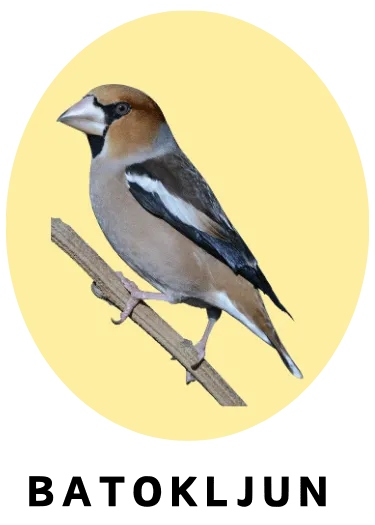
Raising a baby hawfinch
Hand-rearing and rehabilitating a hawfinch
If you have found a hawfinch (Coccothraustes coccothraustes), it is important to assess its condition straight away. If the chick is naked or only sparsely feathered, it needs to be kept warm and given safe conditions, and if it is already well developed but still cannot fly, you will need to hand-rear it and prepare it for its return to the wild.
Ideal housing and temperature
Young hawfinches need warmth because they cannot regulate their body temperature on their own. Put the chick in a cardboard box lined with soft paper or cotton fabric.
Keep the temperature at 32–35 °C if the chick is completely naked, lowering it gradually as its feathers grow.
As a heat source, use a hot-water bottle wrapped in a towel or a heat lamp, but make sure there is a cooler corner so that the chick can move away if it gets too hot.
It should be kept in a quiet, safe place, away from draughts and pets.
Diet and feeding frequency
Hawfinches are mainly seed-eaters, but young chicks need a diet rich in protein and fat.
In the early stages, the best food is insects (soft caterpillars, mealworms, flies, grasshoppers).
You can also use soaked high-quality softbill food mixed with insects.
Hard-boiled egg (without the shell) and chopped fruit such as apples and pears, and berries, are a good addition.
Avoid hard seeds until the chick has developed strength in its beak.
It should be fed every 2 hours during the day, and the amount of food depends on its size and appetite. Each meal should be small enough not to overload the crop, but frequent enough to keep it full all the time.
Teaching it to eat seeds
Once the chick has grown a little, it starts getting used to seeds. The key is to introduce them gradually:
Offer it soft, soaked seeds such as sunflower, millet and flax.
Gradually get it used to harder seeds that it can peck at on its own.
While you are still hand-feeding it, start putting pieces of food (soft fruit, soaked seeds) near its beak, but do not force it to eat on its own straight away. Let it explore them and try to pick them up.
Hold the seeds with tweezers and touch them gently against the tip of its beak, encouraging it to take them by itself. Gradually use the tweezers less until it starts picking up food from the surface.
Put different kinds of food on a small plate or a flat surface – soaked seeds, finely chopped fruit (apple, pear, cherry), crushed nuts. Some youngsters get used to it more easily when they see plenty of food in one place.
Imitate the pecking of adult birds by tapping the food lightly with your finger. This can encourage the chick to start pecking by copying your movements.
If you have another bird that already knows how to eat on its own, the hawfinch can learn by watching it. If there is no other bird, a mirror can serve as motivation.
Gradually reduce the number of hand-fed meals and encourage it to eat more on its own. At first you can still offer it softened food, but the goal is for it to move on to dry seeds and the harder food that hawfinches naturally eat.
Hawfinches use their powerful beak to crack hard seeds such as cherry and plum stones. You can offer it half-opened or lightly crushed seeds so that it realises it can crack them itself.
With patience and consistency, the hawfinch will eventually learn to feed itself.
Preparing for release into the wild
As the hawfinch grows, it is important to give it space to practise flying.
Ideally, use a large outdoor aviary where it can build up strength and coordination.
Put in natural branches so that it develops its muscles and learns to balance.
Provide a natural diet so that it adapts to life in the wild.
The release should be planned in a safe environment, away from predators and close to food sources. It is best to release it in an area where there are other hawfinches so that it can fit in more easily.
Conclusion
Hand-rearing a hawfinch takes patience, knowledge and the right approach. By providing the right diet, safe housing and gradual adaptation to nature, you give it a successful return to the wild. Every stage of hand-rearing must be adapted to the chick’s development so that it grows into a strong, capable bird ready for an independent life in the wild.