
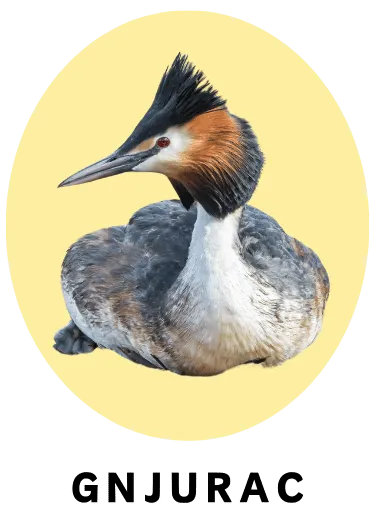
Raising a baby grebe
Hand-Rearing a Young Grebe: Until Its Return to the Wild
Grebes are excellent divers and spend most of their lives on the water, feeding on fish and other aquatic creatures. If you find a young grebe that needs help, it is important to know how to raise it properly and prepare it for its return to the wild.
First steps after finding a duckling
If you come across an abandoned grebe chick, first check its condition:
Injured grebe – If you notice a broken wing, wounds or difficulty moving, the bird should be taken to a vet or a wild bird centre straight away.
Healthy but exhausted chick – It may have strayed from its parents or been carried to an unsuitable place by a storm.
Grebes cannot move normally on land because their legs are adapted for swimming, so they should be kept in a soft box with a towel, in a calm and warm environment.
Diet: what do baby grebes eat?
Grebes are strictly carnivorous, and their diet should include:
Fresh fish – The most important part of the diet, cut into smaller pieces for younger birds.
Small shellfish and shrimps – A good addition to the diet.
Fish with bones – A source of calcium for developing strong bones and feathers.
Fresh water – Although they drink very little, water should always be available.
Feeding in the first days
If the grebe does not eat on its own, food can be offered with tweezers or a dropper. At this stage it should be fed every 2–3 hours, taking care that it does not take in too much food at once.
If the bird is dehydrated, give it an oral rehydration solution (water with electrolytes) before feeding.
Feeding independently
As the grebe grows, it will start eating on its own. You can then offer it:
Whole small fish (such as picarel)
Raw seafood
Fish with skin and bones
Meals are gradually reduced to 3–4 times a day, and human food such as bread, cooked food and milk should be avoided.
Preparing for the return to the wild
For the grebe to return successfully to the wild, it needs to be gradually accustomed to natural conditions:
Provide a water area – Grebes must spend time on the water to develop the muscles they need for swimming and diving.
Reduce contact with people – So that it keeps its natural instincts and does not become tame.
Simulate hunting – Encourage it to catch live fish in the water.
Release into the wild: the key moment
Grebes are best released in calm water, such as a lake or a coastal area with plenty of fish. When releasing it:
Choose a quiet moment, with no predators and no strong currents.
Release it straight onto the water, because it does not cope well on land.
Watch its behaviour – If it immediately swims off and dives, that is a sign it is ready for an independent life.
Conclusion
Raising a grebe takes special attention, the right diet and an approach adapted to its aquatic way of life. With proper care and gradual independence, a young grebe can successfully continue its natural life, joining other birds in the wild.