
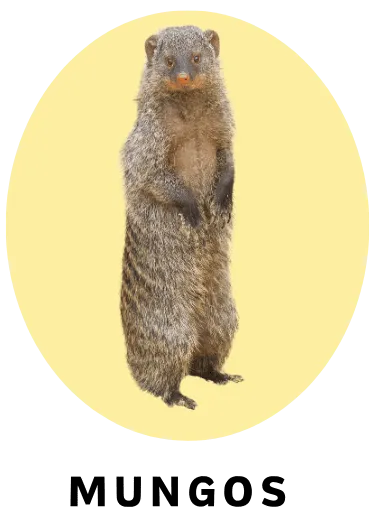
About mongooses
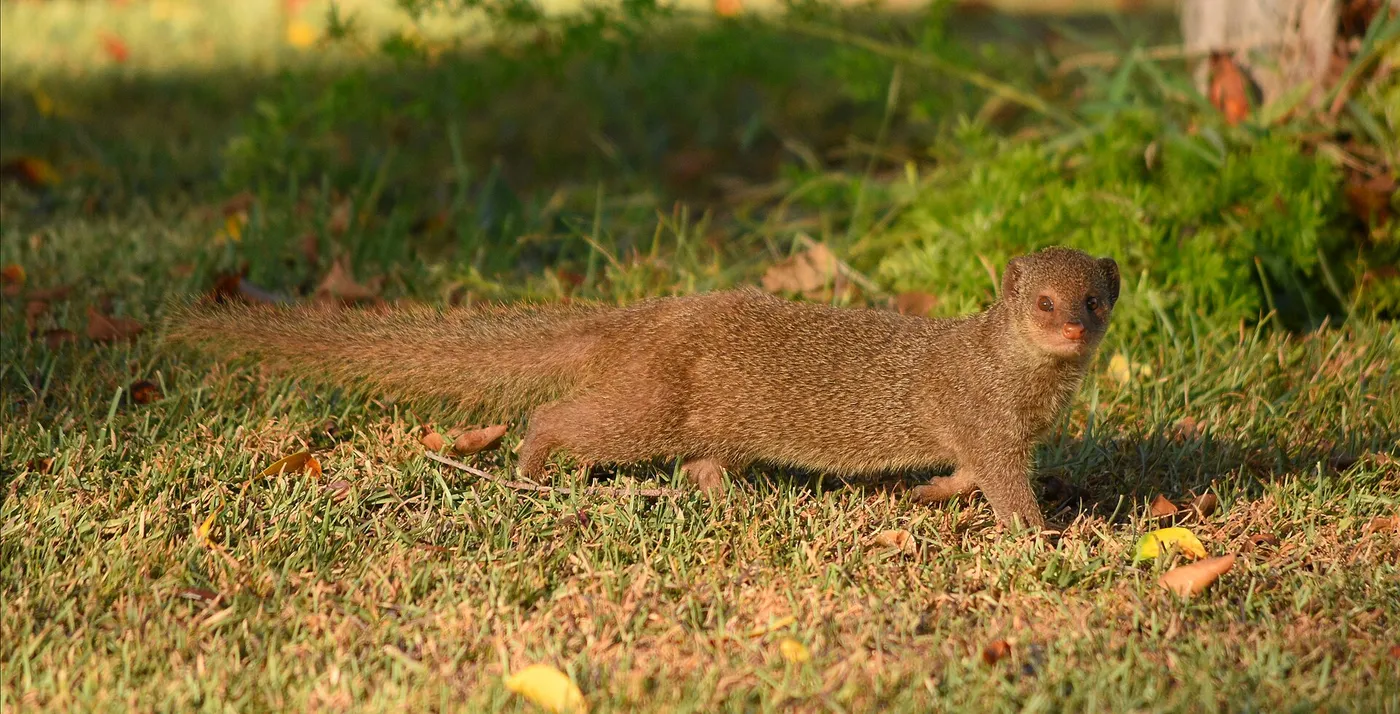
Mongoose (Herpestes javanicus)
Mongooses are fascinating animals known for their exceptional courage, intelligence and adaptability. These small but powerful carnivores belong to the family Herpestidae and are found in the tropical and subtropical regions of Africa, Asia and southern Europe. Their unique behaviour, impressive hunting skills and social structure make them one of the most interesting animals in nature.
Appearance and characteristics
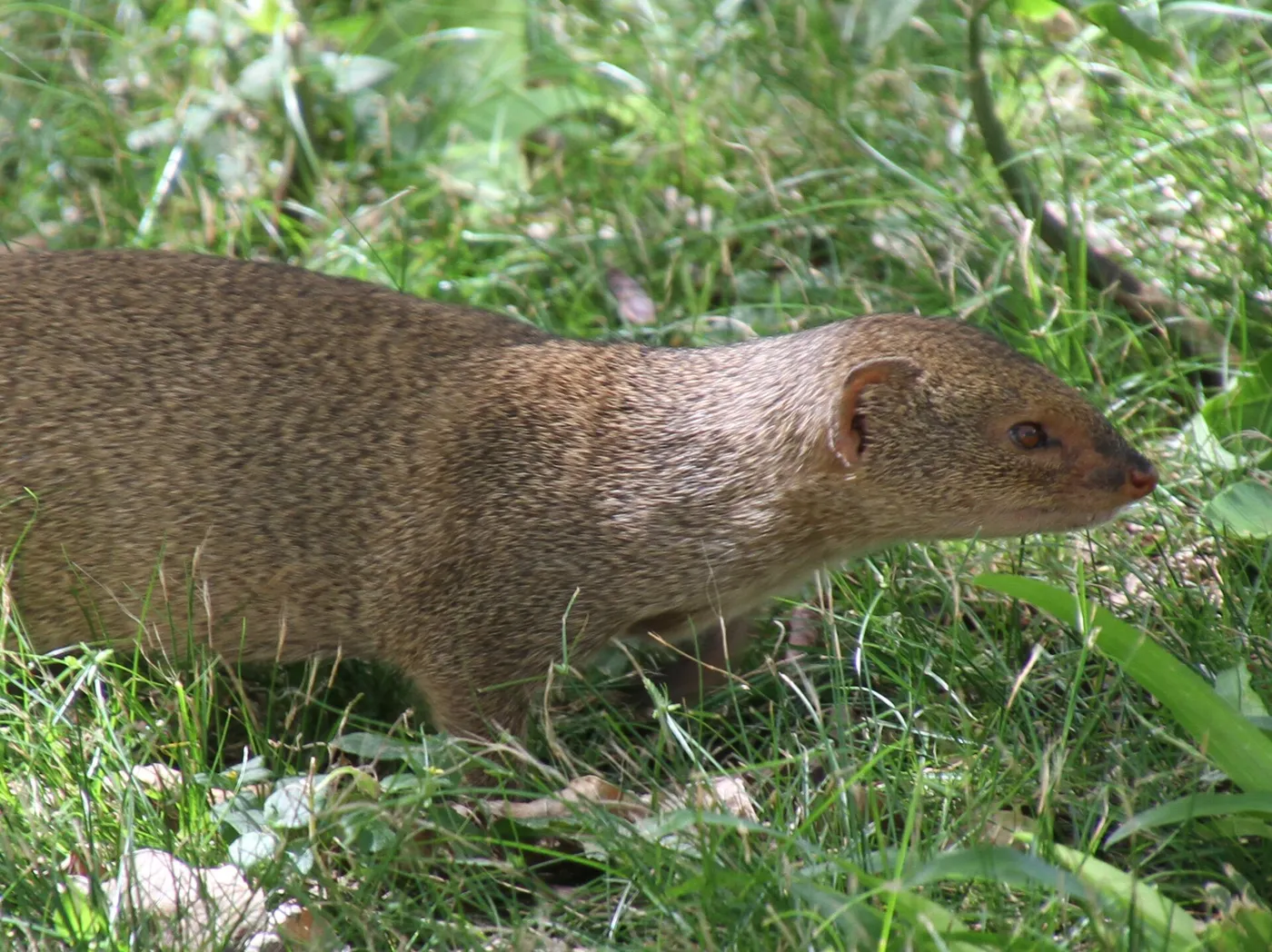
Mongooses are slender, agile animals with a long body and short legs, which allows them to move quickly through grass, shrubs and rocky terrain. Their fur is usually brown, grey or sandy, sometimes with a faint striped pattern, depending on the species. They have sharp claws that help them dig and catch prey, and small, pointed snouts that make it easy for them to find food.
One of the best-known features of mongooses is their extremely fast reflexes, which allow them to take on even the most dangerous predators, including venomous snakes. This incredible survival ability makes them extremely successful hunters.
Habitat and distribution
Mongooses are very adaptable and can be found in many kinds of habitat, including:
Savannahs and grasslands – where they easily hide among tall grass and shrubs.
Woodland – where they use hollow trees and roots for shelter.
Desert regions – where they adapt to harsh conditions and rely on whatever water sources are available.
Urbanised areas – where they are often seen near farmland and settlements, because they hunt rodents.
Diet and hunting skills
Mongooses are versatile carnivores, but they also eat plants when they need to. Their diet includes:
Insects and small invertebrates – such as grasshoppers, spiders and earthworms.
Reptiles and amphibians – including snakes and lizards.
Birds and eggs – they often raid nests in search of food.
Small rodents – such as mice and rats, which makes them useful in the ecosystem.
Fruit and berries – which they eat when their usual prey is scarce.
One of the best-known aspects of mongooses is their fight with venomous snakes. Thanks to their fast reactions, their ability to anticipate the snake’s movements and their natural resistance to venom, mongooses are known to defeat even cobras in deadly duels.
Social structure and behaviour
Mongooses are highly social animals that often live in large family groups. Within these communities they develop a complex system of communication, using various sounds, scents and gestures to pass on information about prey, predators or danger.
There are several interesting aspects of their social behaviour:
Cooperative hunting – they often hunt in groups, increasing their chances of a successful catch.
Territorial defence – they work together to keep intruders out of their territory.
Their ability to live in an organised way makes them extremely successful species in nature.
Breeding and care of the young
Mongooses are extremely adaptable animals, and their breeding varies depending on their habitat. Most mongooses breed once or twice a year, and their social structure often involves cooperation within the group in caring for the young.
Most mongooses have a polygamous mating system, in which one male mates with several females. However, some species form monogamous pairs.
Gestation in mongooses lasts on average 42 to 56 days, depending on the species.
A litter usually has 2 to 5 pups, although some species can have up to 8 young.
The young are usually born in hiding places such as holes in the ground, hollow trees or dense vegetation, which protects them from predators.
At birth, the pups are blind and helpless and rely entirely on their mother and the other members of the group.
Their eyes open after 10 days, and at 3 to 4 weeks of age they begin to explore their surroundings under the supervision of adults.
Suckling lasts about 6 weeks, after which they move on to solid food and begin to learn hunting skills.
At this stage, the young learn to recognise prey and danger through play and by watching the adult members of the group.
Mongooses are known for their highly developed social behaviour, and raising the young often involves the whole group.
Older family members, especially inexperienced females and younger adult mongooses, help the mother guard and feed the pups.
The young learn survival skills through play and by imitating adults, including catching prey and recognising threats.
In some species, females coordinate so that they give birth at the same time, which increases the survival rate of the young.
The young become fully independent at 3 to 6 months of age, but they often stay in the group and help raise the following generations.
They reach sexual maturity between 6 and 12 months, after which they can breed.
These complex social dynamics and shared care of the young make mongooses one of the most successful predators in the ecosystem, ensuring a high survival rate and successful adaptation to different conditions.
Mongooses and people
Because of their exceptional ability to destroy pests, mongooses have often been used as natural protection for agricultural crops. In some parts of the world, especially in Asia, they were introduced to plantations to control populations of rodents and snakes.
Although they are useful in some respects, introducing them into ecosystems where they do not occur naturally can cause biodiversity problems, as they can become an invasive species and threaten native animals.
In many cultures, mongooses are a symbol of courage and resourcefulness. For example:
In Indian mythology, the mongoose is often portrayed as a protector of people against venomous snakes.
In African folk tales, mongooses are considered wise and clever animals.
In some parts of Asia, it is believed that the mongoose brings luck and protection to those who see it.
Their ability to survive and their fearlessness have made them an inspiration for many stories and legends.
The mongoose in Croatia
The mongoose is not a native species in Croatia – it was brought to the Adriatic islands in the first half of the 20th century, primarily to Mljet, to control the population of venomous snakes. Over time it adapted to the local ecosystem and spread to other parts of southern Dalmatia.
Today mongooses in Croatia live:
On the island of Mljet – where they are most numerous and best known.
On the island of Korčula – where they have also managed to settle.
On the Pelješac peninsula and in surrounding areas – where they gradually spread from Mljet.
Although they were initially considered useful for controlling snakes, it later turned out that they had a negative impact on populations of birds and other small animals, as their diet extended well beyond its original purpose.
Conclusion
Mongooses are incredible animals that play an important role in the ecosystem, helping to control pest populations and keep nature in balance. Their combination of resourcefulness, courage and social behaviour makes them unique among small predators.
Whether we look at them through the lens of biology, ecology or mythology, mongooses leave an indelible mark on nature and human culture.