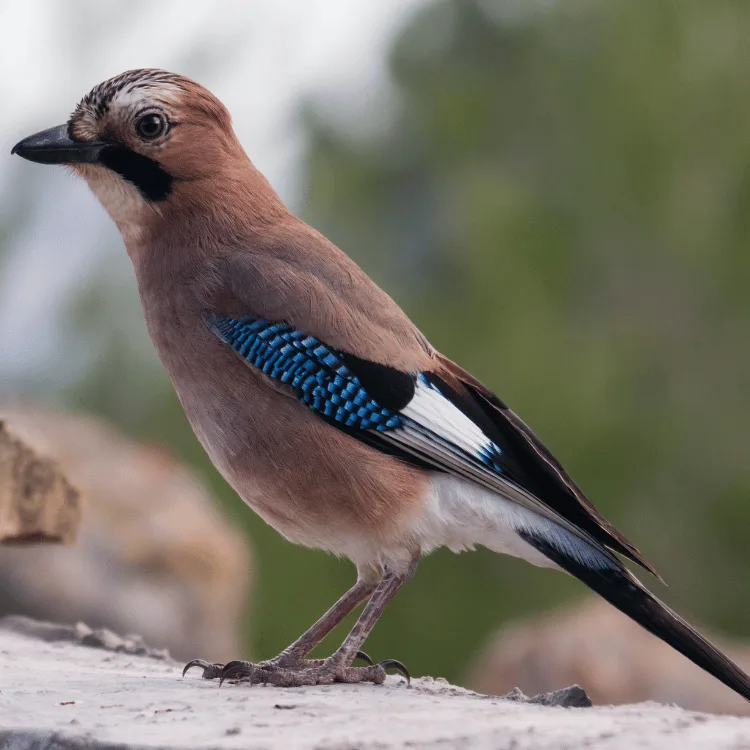
The Eurasian jay (Garrulus glandarius) is a bird recognisable by its vivid colours as well as its loud and varied calls. This bird is known for its adaptable behaviour and its ability to get by well not only in woodland but also in suburbs and parks. Jays are common in Europe, Asia and parts of North Africa, and in Croatia they are very widespread and a common sight in forests and wooded areas.
Eurasian jay (Garrulus glandarius)
Jays and their distribution in Croatia
The best-known jay in Croatia is the Eurasian jay (Garrulus glandarius), which is found across most of the country, from mountain forests to lowland woods and parks. This jay most often lives in mixed and deciduous woodland, and in urban areas it can occasionally be seen in parks or gardens. Although in Croatia the jay is best known for its characteristic colouring and calls, other forms of jay also occur, such as the mountain jay (Garrulus glandarius montanus), which is typical of higher mountain areas.
Jay habits and behaviour
Jays are active birds that often form large, noisy groups, especially in winter. Although they are known for not always tolerating people too close, they are not afraid to approach areas where there is food. Jays are versatile birds that can adapt to different types of habitat, but we most often find them in woodland and along woodland edges. They have a varied diet that includes walnuts, hazelnuts, chestnuts, fruit, seeds, insects and even small animals such as mice or other birds’ eggs. One of the jay’s interesting habits is burying food in the ground, which helps it survive the winter but also makes the jay an important disperser of seeds and plants. What is more, jays are known as outstanding mimics. They copy the sounds of other birds and even other animals, and their voice is loud, rich and varied.
Nesting and family life
Jays usually start nesting in spring, when pairs look for a suitable nesting site. Jays build their nests on high tree branches, often in densely planted areas that give them a safe environment. The nests are usually made of twigs, leaves and grass, and the inside is lined with soft plant material and hair. The female usually lays 4–6 eggs, which she incubates for about 15 days. Both parents take part in feeding the young, and the young jays become active and independent a few weeks after leaving the nest. In family groups, parents can often be seen caring for their young or even helping to feed young from other nests.
Lifespan
Jays can live for 5 to 10 years in the wild, although most do not reach this age because of predators, accidents or disease. In urban areas, where they face fewer predators, jays can live longer. However, jays’ lifespan is also affected by various threats, including habitat loss and collisions with vehicles. Because they tend to move over short distances, jays can occasionally be found in suburbs and urban areas, but they usually return to woodland habitats when necessary.
Facts and research
Jays are the subject of much research because of their intelligence and their ability to mimic. Studies have shown that jays can recognise danger and devise strategies to protect themselves, even from other predators. Interestingly, jays can use tools, for example to reach food that is otherwise out of reach, which places them among the most intelligent birds. Jays are also known for being able to imitate the sounds of other birds and even other animals. Scientists have studied these vocal abilities because they have helped jays adapt better in their dealings with other animals around them. Imitating sounds helps jays to protect themselves or deceive other animals, and it is also used in courtship rituals.
The ecological role of the Eurasian jay
Jays play an important ecological role in woodland ecosystems: through their feeding habits they help spread plant seeds, which contributes to maintaining biodiversity. By burying food, jays help spread plants that would otherwise stay confined to one place. This habit also benefits forests, because jays disperse seeds that can grow in new areas.
Conclusion
The Eurasian jay is a lively, intelligent and adaptable bird of great importance to woodland ecosystems. Its ability to mimic sounds, its adaptability to different habitats and its role in spreading plant seeds make it an indispensable part of forest biodiversity. Although jays can sometimes be loud and noisy, they are clearly remarkably fascinating birds that play a key role in the ecology and life of woodland communities.