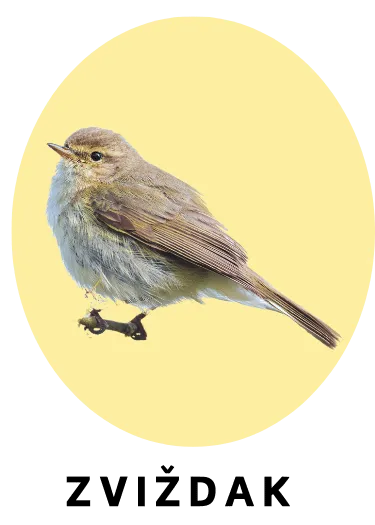
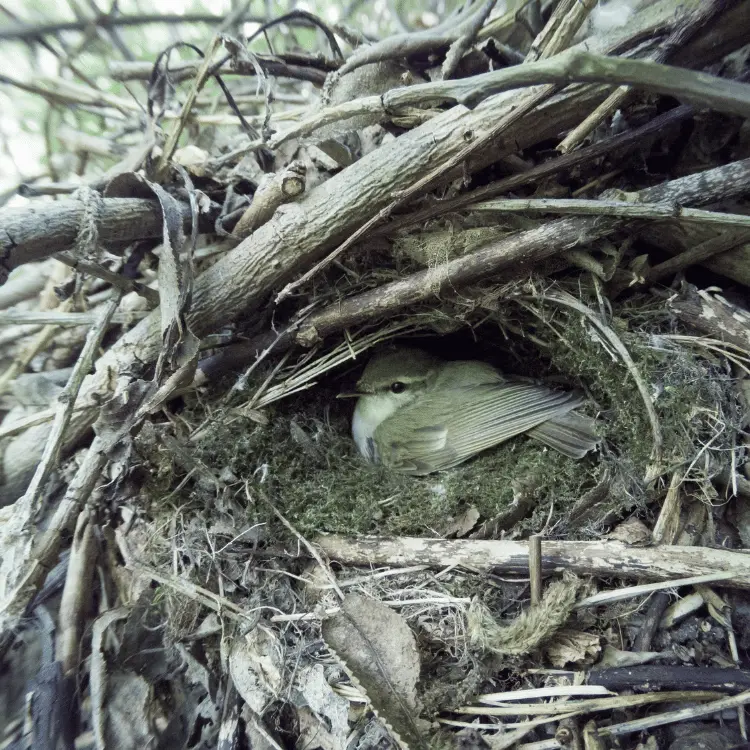
The common chiffchaff (Phylloscopus collybita) is a small but extremely lively songbird from the leaf warbler family (Phylloscopidae). This bird is known for its constant activity and its simple, repetitive song that sounds like “chiff-chaff”, which gave it its English name, common chiffchaff.
Appearance and physical characteristics of the chiffchaff
A tiny body, 10–12 cm long, with a wingspan of 15–21 cm.
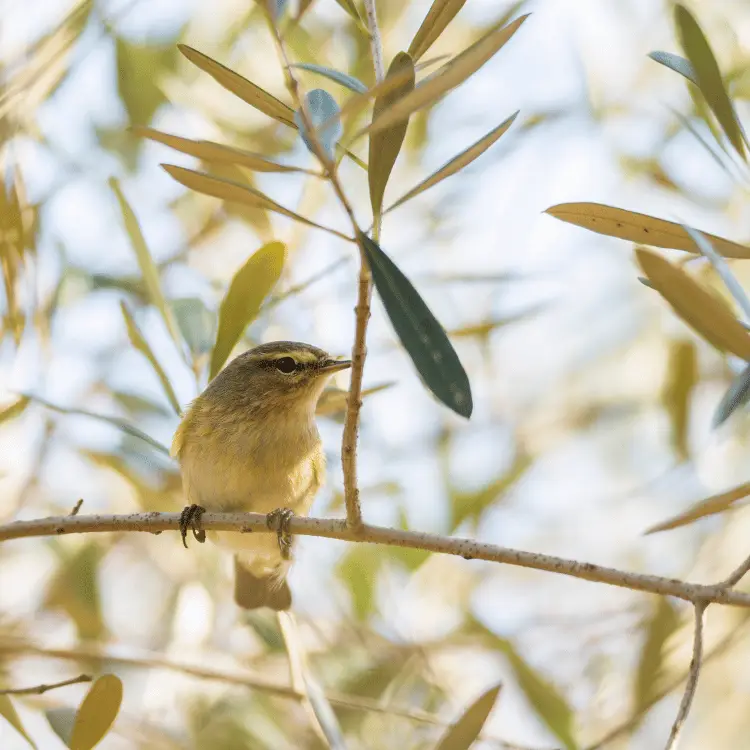
Olive-green plumage on the back, while the underparts are yellowish to buff.
Dark eyes with an inconspicuous pale stripe above them, which gives it a gentle facial expression.
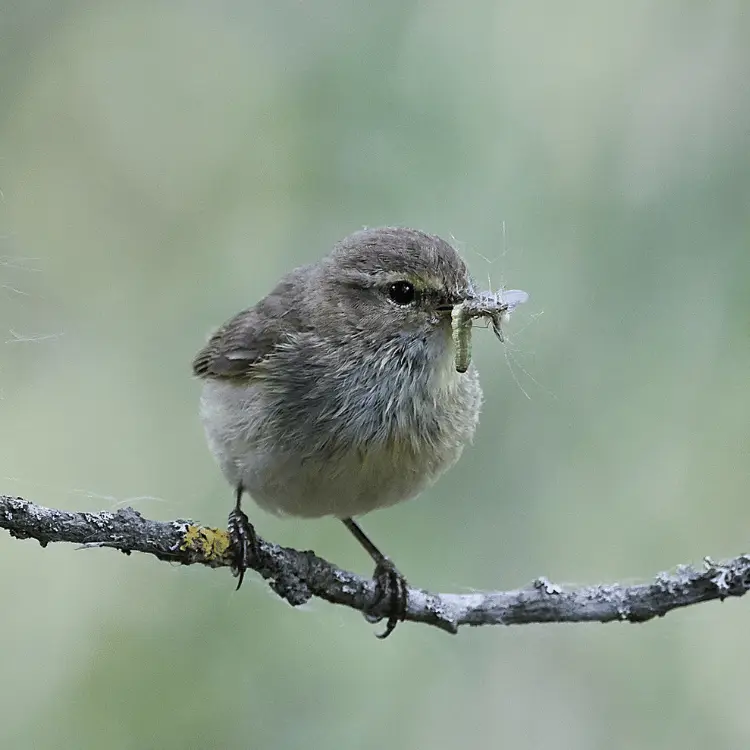
Thin, dark legs, which distinguish it from similar species such as the willow warbler (Phylloscopus trochilus), which has paler legs.
A small, pointed beak, perfect for catching insects.
Chiffchaff habitat and distribution
The chiffchaff is widespread throughout Europe, Asia and North Africa, and its adaptable behaviour allows it to settle in a variety of habitats.
It prefers deciduous and mixed woodland, but can often be seen in parks, gardens and scrub.
It most often stays near water, where insects are plentiful.
In Croatia it is present all year round, especially in coastal regions such as Dalmatia, where the mild climate makes overwintering easier.
Diet – a tiny insect hunter
The chiffchaff is an insectivorous bird, but in winter it adapts its diet to get enough energy.
It feeds on tiny insects, spiders and larvae, which it skilfully hunts among the leaves.
It constantly searches branches and treetops, actively hopping from place to place.
In the colder months it eats berries and small seeds to make up for the lack of insects.
It sometimes visits
Behaviour and breeding
The chiffchaff's song consists of a characteristic “chiff-chaff” sound, repeated over and over.
It often sings in late autumn and winter too, when other birds are silent.
It is extremely active and curious, never staying still in one place for long.
It is most often seen alone or in pairs, but in winter it may join flocks of other small birds.
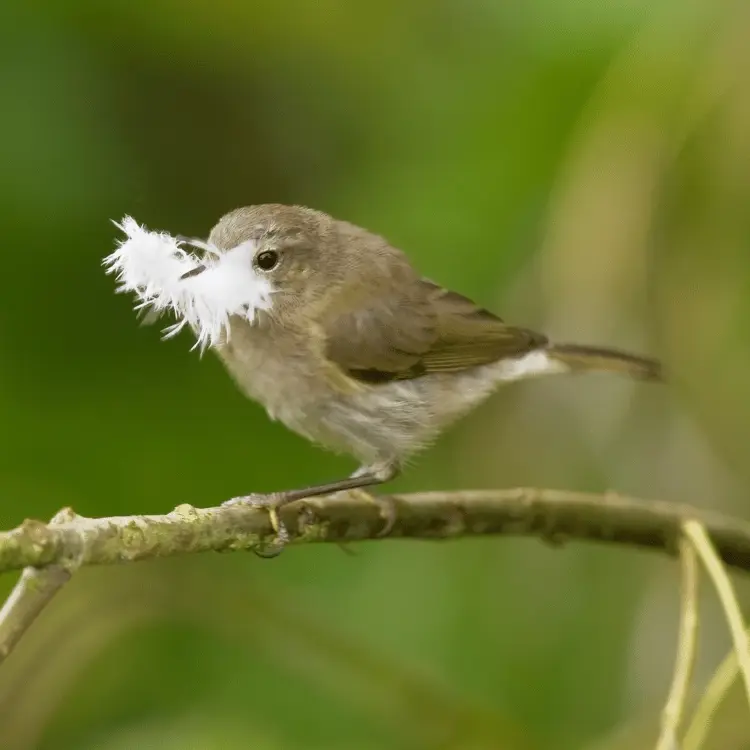
It nests in low shrubs or on the ground, hiding the nest in dense vegetation.
The nest is dome-shaped and made of grass, leaves and moss.
The female lays 4–7 eggs, which she incubates for about 13–15 days.
The young stay in the nest for another 12–14 days, and the parents keep feeding them even after they have left the nest.
Migration and overwintering
Migration and overwintering
More northerly populations migrate to warmer regions, including the Mediterranean, North Africa and the Middle East.
In Croatia, some chiffchaffs stay all year round, especially in coastal areas.
Autumn migration begins in September and October, and in spring they return in March and April.
Threats to the chiffchaff and its protection
Although the chiffchaff is not an endangered species, it faces certain challenges:
Loss of natural habitats due to urbanisation and the spread of farmland.
A decline in insect numbers caused by the use of pesticides.
Predators such as cats, martens and larger birds of prey.
How can you help the chiffchaff?
Preserve natural habitats, especially woodland and scrub.
Put out feeding stations in winter, offering small seeds and berries.
Reduce the use of pesticides to protect insect populations.
Protect nesting areas, especially in gardens and parks.
Conclusion
The common chiffchaff (Phylloscopus collybita) is a small but energetic bird whose distinctive call brings life even to the colder months. Preserving its natural habitat and being aware of how important insects are to its survival are key to the long-term protection of this charming songbird